


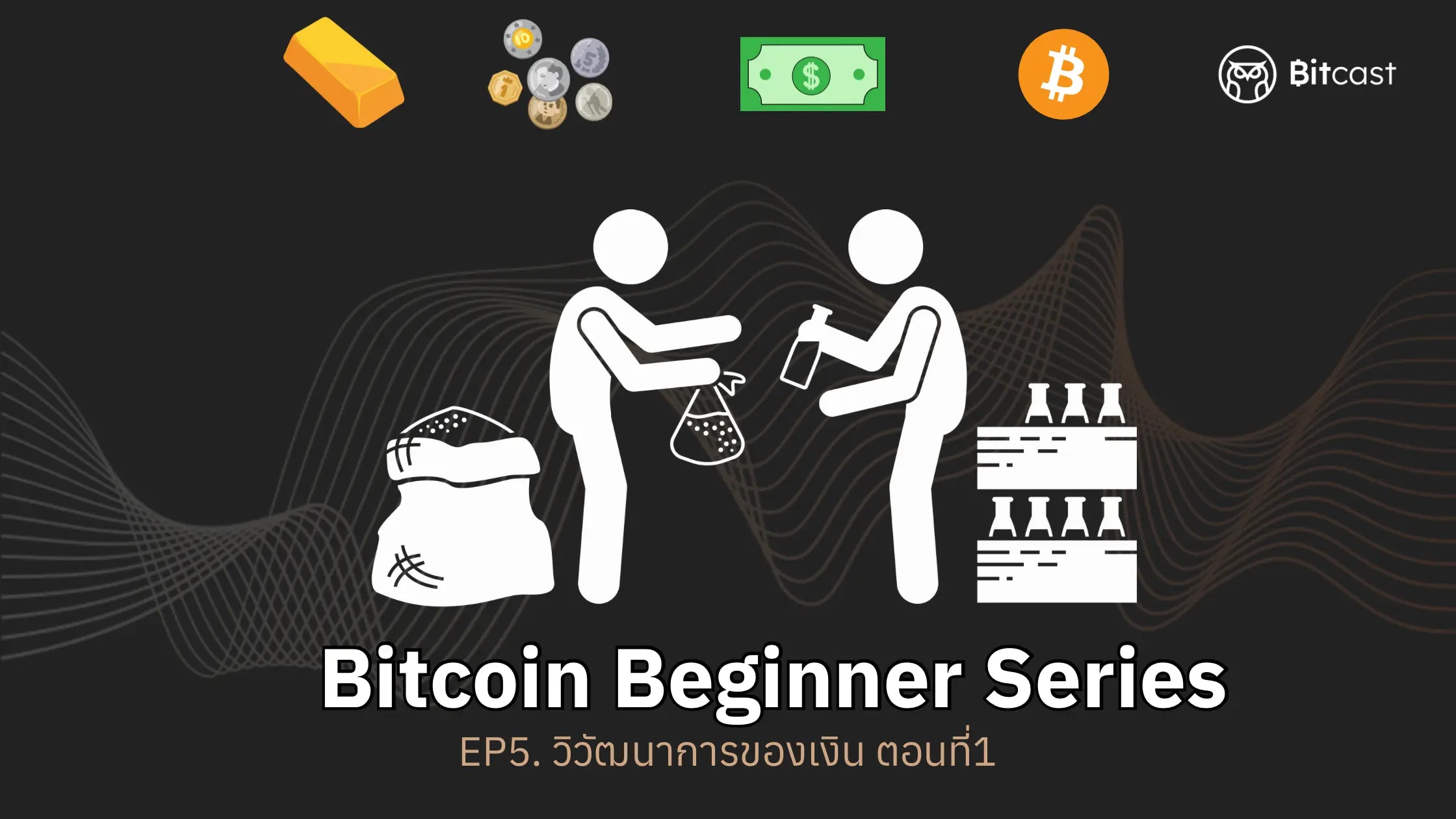
EP 5.1: From Barter to Paper Money
“Money has value, not because it inherently has value... but because of its properties that people 'mutually accept.'”
Why does money have value? Why do we use money instead of bartering?
Today, we use money to buy and sell goods and services, but have you ever wondered where money came from? And why do humans value it so much?
This article will take you through the evolution of money, from the era before currency to the major change in 1971 that turned money into the Fiat Currency we use today.
What is money? Why does it have value?
Money is a "tool" used to exchange value. In the past, it didn't necessarily have to be banknotes or coins; it could be anything that people in a society "mutually accepted," such as seashells, gold, or even digital currency (Bitcoin) today.
What qualities should good money possess?
- Store of Value: It must retain its value and not degrade over time.
- Medium of Exchange: It must be usable as a medium for exchange.
- Unit of Account: It must serve as a unit for measuring the value of goods and services.
Anything that does not possess all these qualities may not be able to serve as stable money in the long term.
Now that we understand what money is and what its qualities are, let's go back and look at the evolution of money in the past.
1. Early Era: Barter System 📍
Before there was "money," people in ancient times used a bartering system, which involved exchanging goods directly, for example:
A person who raised cattle might need clothes → would trade with a weaver.
A person who grew rice might need agricultural tools → would trade with a blacksmith.
What were the problems with this system?
❌ Had to find someone who wanted the same goods (Double Coincidence of Wants).
❌ Some goods could not be divided into smaller units, such as one cow.
❌ Some goods were perishable, making them unsuitable for storing value.
For these reasons, humans began to look for something that could be used as "money."
2. Metal Money Era: The Birth of Coinage 🪙
To solve the problems of the barter system, humans began to use precious metals like gold and silver as a medium of exchange, as they possessed desirable qualities such as not decaying over time, being durable, and being rare.
📍 China: The Beginning of Coinage
640-550 BC – China was the first country to use metal as currency and established the world's first mint.
📍 Lydia (present-day Turkey)
575-550 BC – The city of Lydia developed the oldest mint in Europe.
Lydian coins were made from Electrum (an alloy of gold and silver) and had a stamp to create standardization and facilitate use.
How did the use of coinage help solve problems?
✅ Reduced the problem of finding people who wanted mutually desired goods.
✅ Easier to determine value, no need to negotiate every time.
✅ Helped trade grow by making transactions more convenient and faster.
3. Paper Money Era: From Gold to Banknotes 📜
While metal money helped trade flourish, it also had its drawbacks. For example, if a large amount of money was needed for transactions, a large number of coins would be required, making handling and transportation more difficult, and requiring higher security for the money.
📍Yuan Dynasty (1271-1368) in China, paper money began to be used instead of gold.
Why did paper money start gaining acceptance and use?
✅ Easier to carry than metal coins.
✅ Convenient for spending and transactions.
This was the beginning of the "banknotes" we use today.
4. Bretton Woods: The Birth of the US Dollar as the World's Reserve Currency 🌎
1944 – After World War II, America emerged victorious and possessed the most gold in the world.
America agreed to the Bretton Woods Agreement, which stipulated that:
✅ The US dollar would be the world's reserve currency.
✅ The exchange rate for the dollar would be $35 equal to 1 ounce of gold.
Result:
The dollar became the most influential currency in the world.
All countries had to hold dollar reserves for international trade.
5. 1971: The End of the Gold Standard (Nixon Shock) ⚠️
1971 – The United States faced economic problems due to war and a balance of payments deficit.
President Richard Nixon announced the abolition of the gold standard.
Since then, all global money has become a full Fiat Currency system, as it is today.
Impact:
- Money can be printed without limit.
- "Inflation" occurred, and the value of money decreased as more money was printed. For example, the price of a bowl of noodles 20 years ago was 10 baht; today it has risen to 80 baht.
Today, the money we use daily is "Fiat Currency" with no gold or other assets backing it.
Currently, our world is experiencing the consequences of money not being backed by gold. What will happen next? And how can Bitcoin solve this problem? Stay tuned for the next installment.
Summary: The Evolution of Money Changes with the Times
- From Barter system → Metal money → Paper money → Fiat Currency → (Bitcoin?)
- Today, paper money is no longer backed by assets.
- The value of money depends on trust and government policy.
For further study, you can watch:
- The Evolution of Money for Bitcoin Beginners: Episode 1
- How well do you know money?

แชร์:
Summarize the key points from Bitcoin Conference 2025 in Las Vegas.
Get to Know Hardware Wallet Brands from Around the World EP.4 Series Conclusion