


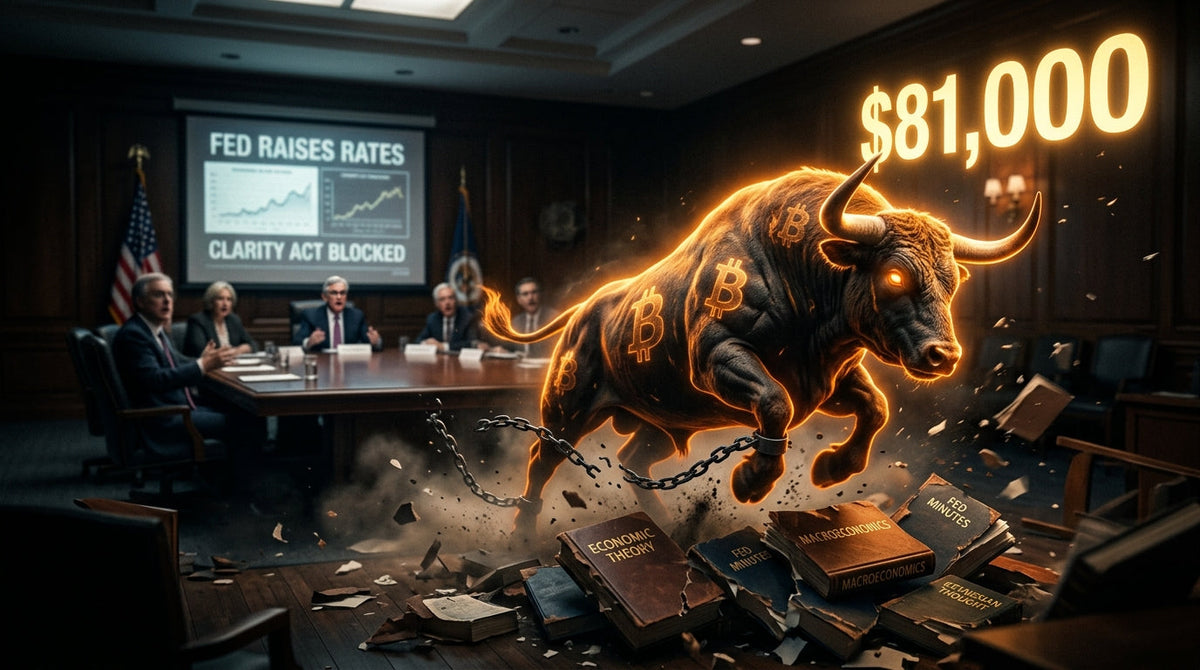
In the world of investing, one of the fundamental theories economists often discuss is the relationship between interest rates, government regulations, and the direction of risky asset prices.
According to traditional principles, when central banks raise interest rates, the cost of capital increases, liquidity is absorbed, and when there is negative news regarding government regulations, highly volatile assets often face heavy sell-offs.
And especially at the beginning of the past week, the crypto market faced simultaneous negative news, including concerns over the Federal Reserve's policy direction and the delay of the CLARITY Act, a digital asset framework bill in the U.S. Senate, which failed to pass with a vote of 49 to 50. These factors pressured the price of Bitcoin (BTC) to retreat to test support around $75,240.
I believe that at that time, the feelings of many of you who were holding tokens must have been filled with quite a bit of concern.
However, what happened after the FOMC meeting on September 16–17, 2026, created a remarkably noteworthy phenomenon in terms of financial economics.
Even though the Fed committee voted unanimously 12-0 to raise the policy interest rate by another 0.25% to the 3.75%–4.00% range, while signaling that high rates would be maintained, and even though the CLARITY Act bill had not yet been passed, Bitcoin's price rebounded strongly, breaking through the $78,000 resistance level and surging to stand above $81,380+ in less than 48 hours.
Why did the market respond in the opposite direction to general concerns? I would like to invite you to decode the mechanisms behind this objectively through 5 key factors in this article.
Overview of the Situation: Two Challenges Faced by the Market
To understand the price reaction, we first need to look at the concrete reality of what occurred.
- Fed Monetary Policy: Under the leadership of new Fed Chair Kevin Warsh, the committee decided to raise interest rates to address the August CPI inflation index, which rose 3.4% YoY, WTI crude oil prices staying above $102 per barrel, and strong non-farm payroll figures of 162,000 jobs. The Dot Plot signaled potential further rate hikes and maintaining rates at an average level of 4.1% throughout 2027.
- Progress of the CLARITY Act: The Digital Asset Market Clarity Act, designed to provide clarity on the division of regulatory authority between the SEC and CFTC, received 49 votes in the Senate, just one vote short of the passing threshold, resulting in a delay in the legislative process.
If evaluated based on news headlines, both of these issues would be categorized as "negative news," so why did the actual market price reflect a major recovery?
Decoding 5 Market Mechanisms: Why Did Bitcoin's Price Jump Past $81,000?
1. Market Priced-In & Uncertainty Resolution
In modern financial markets, information travels at extremely high speeds. Large players do not wait for results to be announced before making decisions; they always assess probabilities and adjust their portfolios in advance.
Data from the CME FedWatch Tool indicates that before the meeting, the market had already assigned an 86%–88% probability to a Fed rate hike, which means that derisking had already occurred, pushing the price down to $75,000.
When the meeting results were announced in line with market expectations, without any new conditions creating negative surprises, the uncertainty that had weighed on the market dissipated, leading to a natural market buy-back (Relief Rally), a common price behavior pattern in financial assets.
2. Resilience to Legislative News and Long-Term Hope (CLARITY Act & Regulatory Resilience)
The issue regarding the CLARITY Act is another highly interesting turning point.
Although the 49-50 vote result caused a temporary delay, institutional investors and large players did not view this outcome as a catastrophe for three key reasons:
- Procedural Delay, Not Rejection of Principles: The narrow 49-50 vote shows that the U.S. Congress significantly acknowledges that the digital asset industry requires a clear legal framework. The draft has already undergone over 126 amendments to address concerns, and the process will continue; it is not a closing of the door on crypto.
- Regulatory Agencies Green-lighting Implementation Without Waiting for Congress: While the bill in Congress stumbled, federal-level regulators have been rapidly setting their own direction. On September 17, 2026, the U.S. SEC announced a 5-year 'Innovation Exemption' for platforms offering tokenized stock trading on blockchain, while also exempting dealer registration requirements for liquidity providers. The SEC officially stated that blockchain technology supports investor self-custody and enables 24/7 instant trading and settlement. Simultaneously, the CFTC submitted a new proposed regulation titled 'Regulation Crypto Asset Transactions and Regulation Crypto Asset Markets' to the White House to prepare for implementing national crypto market oversight. These signals have given financial institutions confidence that the financial rails on blockchain are being established by the executive branch.
- Resilience and Institutional Outlook: When the news of the legislative delay was announced, Bitcoin's price retreated only briefly and quickly absorbed the selling pressure. Large fund managers, such as Dan Morehead (founder of Pantera Capital), stated on CNBC's Squawk Box that "the crypto industry no longer depends on Congress." The fact that the market did not panic-sell sent a positive signal to investors that the market has a strong buyer base capable of overlooking short-term political volatility.
3. Derivatives Market Liquidations (Short Liquidations & Squeeze)
The technical momentum accelerating the price came from behavior in the derivatives market.
Before the meeting, many traders opened short positions expecting that the rate hike and CLARITY Act delays would push the price below support. But when the price did not decrease as expected and buy-backs began, the short positions started to be liquidated as stop-losses were hit.
Data from TradingView Derivatives Report notes that during the recovery past $78,000, over $80 million in short contracts were forcibly closed, and when the price moved past $80,000, another $183 million in liquidations were triggered.
Forced buying from the system totaling over $263 million became a massive momentum boost that accelerated the price, pushing Open Interest past the $27.3 billion level.
4. Role of Long-Term Institutional Capital via US Spot Bitcoin ETFs
Another pillar supporting the price structure in this cycle is capital inflow from US Spot Bitcoin ETFs.
Trading data indicates that as soon as the uncertainty surrounding the Fed and the Senate passed, institutional capital clearly flowed back into ETFs:
- Thursday, September 17th saw net inflows of approximately $160 million.
- Friday, September 18th saw net inflows accelerate to $324.6 million.
Within 48 hours of the meeting, spot ETFs saw a total net inflow of nearly $500 million. These pension fund and family office investments have a medium- to long-term investment horizon (3–5 years or more), so they prioritize asset allocation according to plan rather than panicking over quarterly interest rate trends.
5. US Public Debt and the Long-term Outlook on Currency Debasement (Debt Dynamics)
From a macroeconomic perspective, central bank interest rate hikes not only impact the business sector but also place immense pressure on the US government's own fiscal position.
Currently, US public debt has soared past $35 trillion, and with the 10-Year Treasury Yield holding above 5.04%, the US government's net interest expense has surpassed $1 trillion per year.
When interest expenses exceed the rate of economic growth, many macro analysts observe that the government may face limitations in servicing debt through tax revenue alone, which, according to historical lessons, often ends with central banks having to return to monetary easing to accommodate future debt.
This concern over currency debasement has led some investors to begin allocating capital into assets with absolute scarcity, such as gold and Bitcoin—capped at 21 million units—to serve as a tool for long-term structural risk diversification.
Comparison Summary: Traditional Monetary Theory vs. Current Market Reality
| Dimension | Traditional Monetary Theory | Current Market Reality |
|---|---|---|
| Effect of Rate Hikes | Liquidity decreases, risky assets must correct | Market prices in advance, recovers once uncertainty is gone |
| Legislative News (CLARITY Act) | Viewed as a major hurdle, triggers heavy sell-offs | Viewed as a procedural delay, while adoption trends continue |
| Holder Structure | Driven mainly by retail investors and short-term leverage | Institutional capital via Spot ETFs systematically absorbs supply |
| View on Public Debt | Government bonds are the ultimate safe-haven asset | Considers long-term debt burdens, seeks scarce assets for inflation hedge |
Conclusion
Bitcoin's rebound above $81,000 amidst both Fed rate hikes and delays in the CLARITY Act is a clear example that financial markets often move in dimensions far deeper and more complex than general headlines suggest.
For those of you following the market, I encourage you to view this with understanding and mindfulness:
- For short-term speculators: If you decide to take profit according to your plan to use liquidity for daily expenses, supporting your family, or relieving real-life financial burdens, that is a decision that is valid and complete in its own right.
- For long-term savers: If you choose to look past daily price volatility to hold onto assets as a guarantee of long-term wealth according to your goals, that approach is equally appropriate for your personal context.
Everyone has their own portfolio; no single strategy is perfectly superior to others. The important thing is whether we understand the risks of what we have chosen.
Self-custody via a hardware wallet is a foundational tool that helps us truly own our assets with peace of mind for the long term. Learning about holding private keys and storing coins yourself using a hardware wallet is not about being trendy or following the crowd; it is a technological tool that helps eliminate counterparty risk and returns the power to control assets back into our hands.
If you are interested in learning how to store your coins safely, you can read our guide on How to Store Bitcoin Safely, check out 7 Misconceptions About Hardware Wallets for beginners, or if you are planning your portfolio allocation, you can read our perspective on When Should We Sell Bitcoin?. If you are interested in browsing authentic hardware wallets with local Thai support, you can visit our Bitcast official product collection.
How do you all view the breakout above $81,000 this time? Do you see it as the beginning of a new cycle, or just a short-term relief rally? Feel free to share your thoughts, and if you have questions about usage or want to know more about hardware wallets, feel free to reach out via LINE @bitcast.
Frequently Asked Questions (FAQ)
Q1: Why did this Fed rate hike not cause the price of Bitcoin to drop according to theory?
Because the futures market and institutional investors had already priced in over 88% of the hike, risk had been reduced prior to the meeting. When the meeting results matched expectations with no additional negative factors, the uncertainty was resolved, paving the way for a natural market rebound (Relief Rally).
Q2: How did the delay of the CLARITY Act impact the price of Bitcoin?
Although the bill did not pass the vote in the Senate by 49 to 50, the market viewed it as merely a procedural legislative delay, not a rejection of the principles. The fact that the price did not collapse reflects that the market is highly resilient and recognizes the long-term trend toward regulatory clarity.
Q3: How did the Short Squeeze phenomenon contribute to driving up prices?
Prior to the meeting, a large number of short positions were opened. When the price failed to drop and instead rebounded, risk management systems forced liquidations, which is equivalent to automatically placing buy orders back into the market. With over $263 million in short liquidations, this served as fuel to push the price past $81,000.
Q4: What role do US Spot Bitcoin ETFs play in price movement?
Spot ETFs are the primary channel attracting long-term investment capital from financial institutions. Within 48 hours of the Fed meeting, total net inflows were nearly $500 million. This capital group has a long-term holding horizon, thus helping to significantly absorb supply in the market.
Q5: How should Bitcoin holders manage risk during periods of market volatility?
You should clearly evaluate your financial goals and your holding period. For long-term holders, moving assets off exchanges to store them yourself (self-custody) via a hardware wallet helps reduce counterparty risk and creates confidence in true asset ownership.


แชร์:
Where is the best place to buy a Trezor in Thailand? A guide to buying genuine, safe devices without customs risks, complete with a local Thai warranty.
"Bitcoin Native": A Checklist to Measure Your True Bitcoiner Status!