
Why Use a Hardware Wallet?
In an era where digital assets and cryptocurrencies are growing rapidly, a crucial question for investors and digital asset holders is: "How do we keep our assets safe?" While software wallets and exchanges offer convenience, they come with unavoidable security risks, including hacking, system vulnerabilities, or even third-party control.
Hardware wallets have therefore become an important choice for those looking to enhance the security of their digital assets. By storing private keys in a device completely isolated from the internet, they reduce the risk of cyberattacks and give you complete control over your assets.
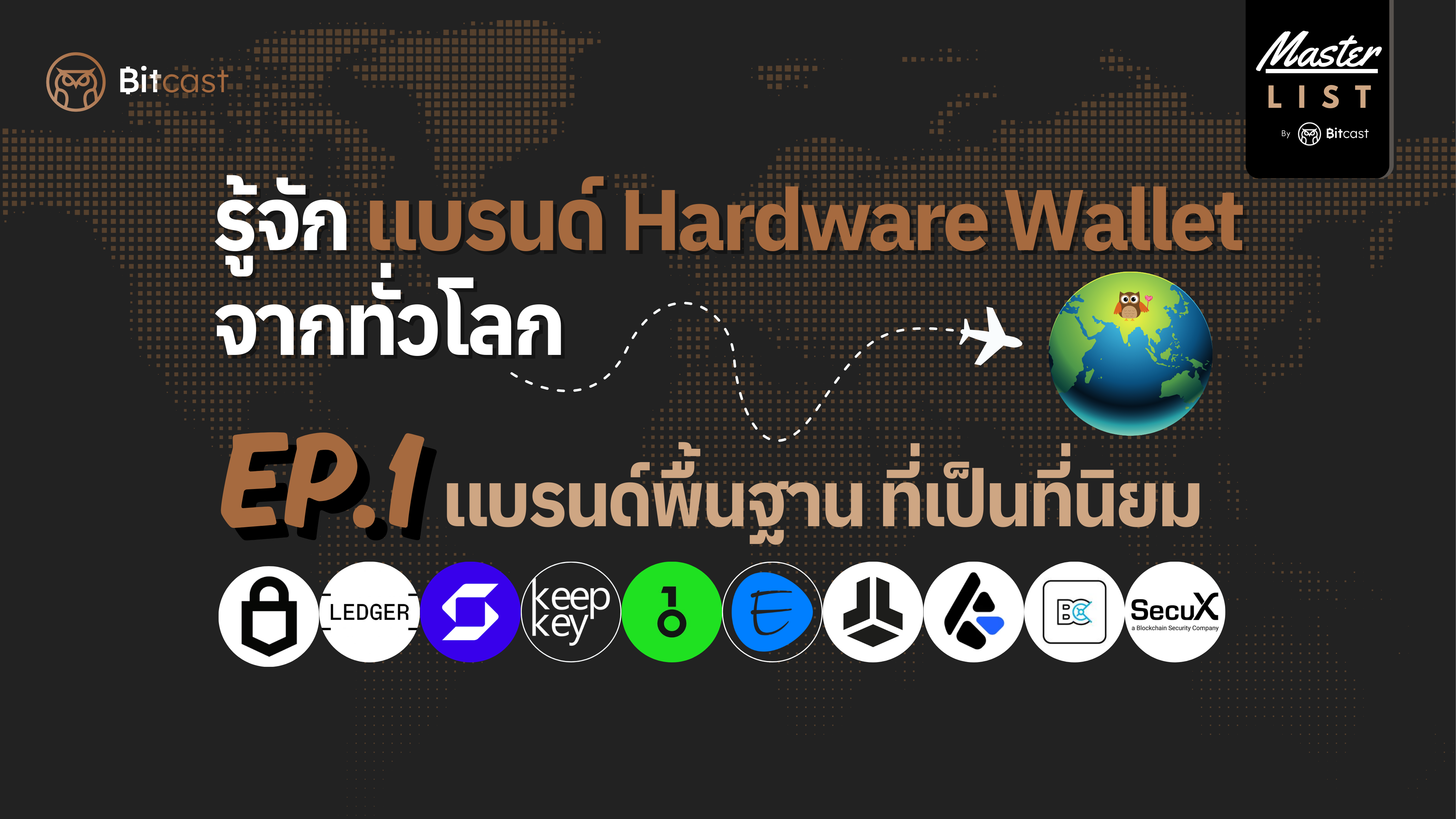
This article series, Master List: Discover Hardware Wallet Brands from Around the World, will introduce you to 30 hardware wallet brands globally, along with their unique features and suitability, to help you have more options and confidently choose the device that best meets your needs.
EP.1 Popular Fundamental Brands
What criteria did we use for EP.1?
To understand the world of hardware wallets systematically, this Master List series divides brands into 3 groups. In EP.1, we start with the main group, which is considered popular in the industry, based on the following criteria:
- Globally popular – Has a large number of users and is widely discussed.
- Secure and reliable – Audited by experts and has a good reputation for security.
- Supports various coins – Compatible with major coins and tokens in the market.
- Easy to use – Simple interface, suitable for both beginners and experienced users.
These are considered the "popular fundamental brands" that a large number of people in the digital asset industry are interested in.
Overview of 10 Hardware Wallet Brands
This group consists of mainstream brands with a global user base, supporting a wide range of coins, and featuring user-friendly systems. They are suitable for both beginners and general investors.
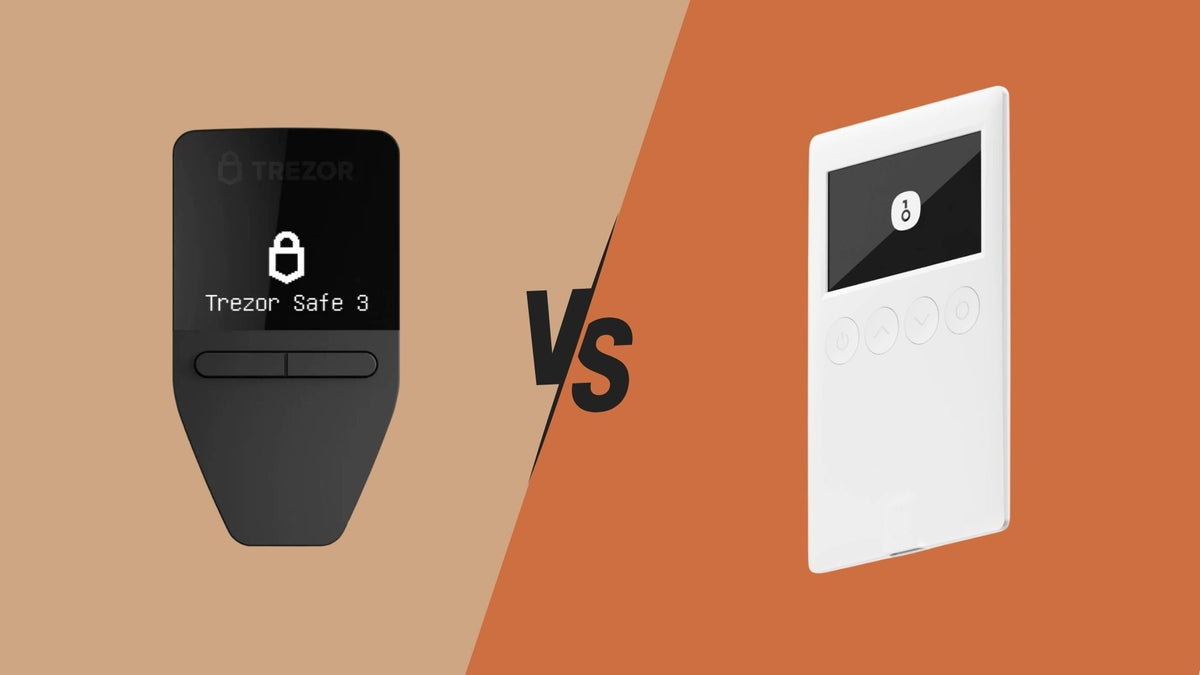
- Trezor (trezor.io) – Pioneer in the hardware wallet industry, secure and easy to use.
- Ledger (ledger.com) – Global leader from France, supports many coins, convenient app.
- SafePal (safepal.io) – Affordable portable wallet, supported by Binance.
- KeepKey (keepkey.com) – Simple design, easy to use, uncomplicated.
- OneKey (onekey.so) – Rising brand from Asia, focused on Open Source.
- Ellipal (ellipal.com) – 100% Air-gapped, uses only QR Code, no cables or Bluetooth.
- BitBox (bitbox.swiss) – Small, compact design, meticulously made in Switzerland.
- Keystone (keyst.one) – Features Fingerprint, touch screen, Air-gapped connection via QR Code.
- BC Vault (bc-vault.com) – Stores multiple accounts in one device, uses encrypted backup instead of seed phrase.
- SecuX (secuxtech.com) – Brand from Taiwan, large touch screen, easy to use.
Detailed Information for Each Brand
1. Trezor
- Country of Origin: Czech Republic
- First Launched: 2014
- Popular Models: Trezor One, Trezor Model T, Trezor Safe 3, Trezor Safe 5
-
Highlights:
- The world's first brand to launch a hardware wallet.
- Uses open-source software.
- Supports major coins like BTC, ETH, LTC, and ERC-20.
- Features Passphrase and Shamir Backup for enhanced security.
-
User Experience:
- Installation and use via Trezor Suite are easy, suitable for both beginners and experienced users.
- Regular software updates and a large user community.
-
Caveats:
- Trezor Model One does not support some newer coins.
- Trezor Model One does not have a Secure Element, which some might see as riskier than other models, but others argue that the absence of a Secure Element allows all code (even on the microcontroller) to be auditable.
2. Ledger
- Country of Origin: France
- First Launched: Founded in 2014 (but first product launched in 2016)
- Popular Models: Ledger Nano S Plus, Ledger Nano X, Ledger Stax
-
Highlights:
- Uses a Secure Element chip, similar to those in banks.
- Ledger Live app is user-friendly and supports over 5,000 coins.
- Can be used with mobile devices via Bluetooth (Nano X).
- Offers Ledger Recover service for recovery (optional).
-
User Experience:
- Smooth UI/UX in Ledger Live, suitable for both beginners and experienced users.
- Can view and send NFTs directly via Ethereum accounts in Ledger Live.
-
Caveats:
- The Ledger Recover service raises privacy concerns among privacy-focused users.
- Not 100% open-source.
3. SafePal
- Country of Origin: Singapore
- First Launched: 2018 (supported by Binance Labs)
- Popular Models: SafePal S1, SafePal S1 Pro, SafePal X1
-
Highlights:
- Affordable, but uses QR Code Air-gapped technology (no cables or Bluetooth).
- Supports over 30 blockchains and more than 10,000 tokens.
- Has a SafePal app for both Android/iOS to manage assets.
-
User Experience:
- Small, lightweight design, suitable for portability. Easy and fast to use with the app.
- The app's interface looks modern and easy to understand.
-
Caveats:
- Cannot be deeply integrated with popular open-source software like Electrum.
- Care must be taken in storing the device and password, as there is no Secure Element.
4. KeepKey
- Country of Origin: United States of America
- First Launched: 2015 (currently owned by ShapeShift)
- Popular Models: KeepKey
-
Highlights:
- Sleek design with a large screen.
- KeepKey Client & ShapeShift Dapp Store software.
- Supports 40+ blockchains and 1,000+ tokens, including major assets like BTC, ETH, LTC, XRP, etc.
-
User Experience:
- Clean UI/UX and easy to use for both beginners and experienced users.
- Firmware stability is open-source (Deterministic build), allowing community review.
-
Caveats:
- No Bluetooth/Wi-Fi/NFC: Connects only via USB (reduces wireless risk but less flexible).
- Client Browser Extension Platform Risk: Only download from official sources to avoid fake plugins.
5. OneKey
- Country of Origin: Hong Kong
- First Launched: 2019
- Popular Models: OneKey Mini, OneKey Classic 1S, OneKey Pro
-
Highlights:
- Full open-source for both hardware and software, with code available on GitHub (https://github.com/OneKeyHQ/firmware-pro/blob/main/docs/core/misc/slip0039.md?utm_source=chatgpt.com)
- Supports 60+ blockchains & 5,000+ tokens via OneKey App, including Buy/Swap/Stake/NFT.
- Recovery with SLIP-39 (Shamir Backup).
-
User Experience:
- OneKey App UI/UX is smooth and convenient for both beginners and experts.
- Easy to connect with Electrum, Sparrow, MetaMask (MetaMask recently directly supports Air-gapped OneKey).
- Some models are small and portable, with overheat protection.
-
Caveats:
- The OneKey App is still partially closed-source (even though the firmware is open-source). Those who prioritize code auditing need to consider this.
- Pro & Mini models have battery/Bluetooth, but for maximum network isolation, the Classic 1S (air-gapped) should be used.
6. Ellipal
- Country of Origin: Hong Kong
- First Launched: 2018
- Popular Models: Ellipal Titan, Ellipal Titan Mini
-
Highlights:
- 100% Air-gapped, connects only via QR Code, no USB or Bluetooth.
- Device made of aluminum alloy, robust and resistant to physical attacks.
- Ellipal app is easy to use on iOS/Android, managing over 40 blockchains and 10,000+ tokens.
- Offline firmware updates via microSD to maintain full air-gapped security.
-
User Experience:
- The interface looks modern and easy to understand on both iOS and Android.
- Users appreciate the "maximum security" feel due to the complete lack of wireless connections.
-
Caveats:
- QR scanning might be slower than USB or Bluetooth.
- Relies solely on the Ellipal app, not broadly compatible with external software.
7. BitBox
- Country of Origin: Switzerland
- First Launched: Founded in 2015 (as a spin-off from ETH Zurich) and first product launched in 2016.
- Popular Models: BitBox02 Bitcoin-only / Multi edition
-
Highlights:
- Small and compact, easy to carry.
- Works with microSD for secure data backup.
- Air-gapped options: BitBox02 can be used air-gapped with microSD.
-
User Experience:
- Easy to use with BitBoxApp and features a beautiful UI.
- Responsive side touch sensors for smooth operation.
-
Caveats:
- MicroSD must be kept secure if used as the primary data backup.
- The Multi edition has risks due to supporting multiple coins (surface attack area).
8. Keystone (formerly Cobo Vault)
- Country of Origin: Hong Kong
- First Launched: 2021 (rebranded as Keystone officially)
- Popular Models: Keystone 3 Pro
-
Highlights:
- Large touch screen, easy to use.
- Features fingerprint scanning.
- Air-gapped via QR Code, no cables or Bluetooth.
-
User Experience:
- Supports integration with Bitcoin software such as Sparrow, Specter, BlueWallet, MetaMask (via PSBT/QRCodes).
- Elegant and user-friendly interface, even advanced features come with on-device explanations and comprehensive documentation.
-
Considerations:
- Higher price than other brands in the same category.
- Requires a fair amount of technical understanding; using PSBT, managing QR workflows, and SLIP-39 shares can be complex for beginners.
9. BC Vault
- Country of Origin: Slovenia
- First Released: 2018
- Popular Model: BC Vault One
-
Highlights:
- Does not use a conventional seed phrase; employs encrypted backup and multiple layers of passwords.
- Can store multiple accounts on one device (multi-wallets).
- Features an OLED display to confirm transactions.
-
User Experience:
- Requires installation and use via the BC Vault Application (available on MacOS, Windows, Linux), which is designed to be secure and supports a multi-language GUI.
- Suitable for intermediate to advanced users who need to manage multiple vaults in one place without confusion.
-
Considerations:
- Requires an understanding of managing multiple password and backup layers.
- Not 100% suitable for beginners.
10. SecuX
- Country of Origin: Taiwan
- First Released: 2018
- Popular Models: SecuX V20, W20, Neo-X
-
Highlights:
- Large, vibrant touch screen, easy to use.
- Connects via both USB Type-C and Bluetooth 5.0 (V20/W20 support Bluetooth, W10 is USB-only).
- Uses a Secure Element CC EAL5+ chip, same level as banks.
- Supports over 10,000 cryptocurrencies, including NFTs (ERC-721/1155) and ERC-20 standard tokens across more than 300 blockchains.
-
User Experience:
- Convenient connectivity via USB or QR-based Bluetooth with mobile phones and computers, smooth for both beginners and experts.
- Ergonomic design, robust materials, resistant to daily wear and tear.
-
Considerations:
- Bluetooth may pose security risks if not turned off when not in use.
- Relies solely on the SecuX app; widespread open-source software support is still lacking.
🔒 Conclusion
The world of Hardware Wallets might seem complex at first glance, but its essence is very simple — we are finding a way to protect what is ours... to truly keep it ours.
From the global brands you've learned about in this EP.1, you'll see that each brand has its own "concept" and "approach." Some brands prioritize advanced security, some focus on ease of use, some are open-source for transparent auditing, and some come with new features tailored for a new generation. But remember, "no Hardware Wallet is best for everyone." There is only the Hardware Wallet that is most suitable for "you."
✅ If you're still undecided, try starting with these 3 questions:
- How much importance do you place on "security level"?
-
- If you want to be completely disconnected from the online world, consider an Air-gapped Wallet like Ellipal or Keystone
- If you're comfortable using an app for connection, devices like Ledger, Trezor are convenient and offer a sufficient level of security.
- Which "coins" do you want to use?
-
- If you focus solely on Bitcoin, consider BitBox02 Bitcoin-only
- If you have a diverse portfolio, such as ETH, NFTs, or DeFi coins – Ledger, SafePal, OneKey, SecuX might be suitable.
- How comfortable are you with "ease of use"?
-
- If you're a beginner → start with brands that have a friendly UI, such as Trezor, OneKey, SafePal, Ledger
- If you have experience or are tech-savvy → try brands that are more open, such as Keystone, BC Vault
Finally, in the crypto world, there are no banks, no central authority. This means "you" are your own bank, and a Hardware Wallet is a safe deposit box you design yourself. Starting to learn and choosing the right Hardware Wallet is the first step towards true financial freedom.
[ If you are interested in Trezor, OneKey, or Keystone brands, you can purchase from authorized dealers like Bitcast to ensure genuine products, reliable after-sales support, and a full 1-year warranty. You can click here to view products and place an order: → Bitcast ]
Thank you for joining us on this series — see you soon in EP.2: Brands focusing on innovation and new features.
![[NEWS] สรุปประเด็นกฎหมายคริปโตล่าสุด](http://thaibitcast.com/cdn/shop/articles/Cover11-1791345226262.png?v=1791345941&width=3840)
แชร์:
Is it really possible to plan your retirement with Bitcoin?
Why the Keystone 3 Pro is Interesting - Pre-Use Review