


- A famous case: James Howells and the lost hard drive
- What does a Bitcoin Wallet actually store?
- The early days of Bitcoin: Everything was on the computer
- Paper Wallets: Keys written on paper
- Brain Wallets: When people tried storing Bitcoin in their memory
- As Bitcoin usage grew, so did the evolution of wallets
- A major turning point: When backing up wallets became easier
- Mobile Wallets: When Bitcoin entered our phones
- Hardware Wallets: When private key storage moved off the computer
- From holding coins to Web3 interaction
- Why can't early adopters access their Bitcoin anymore?
- The Bitcoin is still there, but the keys are lost
- Lessons we can apply today
- Keep wallet backups safe
- Verify your own backups
- Choose a storage method that works for you
- Summary
- Frequently Asked Questions about Bitcoin Wallets
- Is Bitcoin actually stored in the wallet?
- If I lose my hardware wallet, is my Bitcoin gone?
- What is a Seed Phrase?
- What happens if the Seed Phrase is lost?
- Why does Bitcoin remain on the blockchain even if the private key is lost?
Many people have likely seen news about individuals who own large amounts of Bitcoin but can no longer access it. Why does this happen?
Some have lost hard drives, others have forgotten passwords, some stored wallet files on old, broken computers, and some have simply forgotten where their important information was kept.
These stories make people wonder, "Why didn't they just write down their Seed Phrase?"
The answer is that in the early days of Bitcoin, the methods for backing up wallets were not as convenient or standardized as what we are accustomed to today.
Back in the early days, many users had to manage their own wallet files and private keys. If that data was lost without a backup, it often meant losing the right to control those Bitcoins forever.
This article will take you back to see how people stored and backed up their wallets from the very beginning of Bitcoin, and why some people's Bitcoin remains on the blockchain while they can no longer access it.
A famous case: James Howells and the lost hard drive
When it comes to people who lost access to their Bitcoin, the case of James Howells is likely one of the most well-known.
He was a British citizen who mined Bitcoin during the early stages of the network, and later, the hard drive containing the vital information needed to access his Bitcoin was accidentally thrown away.
The Bitcoin associated with that hard drive is still on the blockchain; it didn't disappear. It's just that we no longer have the crucial information needed to access that wallet, making it impossible to move those coins.
The Bitcoin is still on the blockchain, but if the key to accessing it is lost, no one can manage those funds.
This story clearly reflects a major problem with Bitcoin wallets in the early days. At that time, accessing your Bitcoin could be tied to data stored on a single computer or drive. If the device was lost, broken, or discarded without a backup, it could mean losing access to the coins forever.

What does a Bitcoin Wallet actually store?
Before going back into history, let's understand what a Bitcoin wallet is.
Many people might think that a wallet is where Bitcoin is stored, but in reality, Bitcoin is not kept inside a wallet like cash in a physical billfold.
Bitcoin is recorded on the blockchain. What the wallet manages is the vital information used to control your Bitcoin, such as the private key.
Simply put, a private key is like a key that proves we have the right to control the Bitcoin on the blockchain.
Therefore, if we own Bitcoin but lose the private key or the information used to recover the wallet, and we don't have a backup, we might still see those Bitcoins on the blockchain, but we can't use them anymore.
This is why taking care of private keys is just as important as buying Bitcoin.
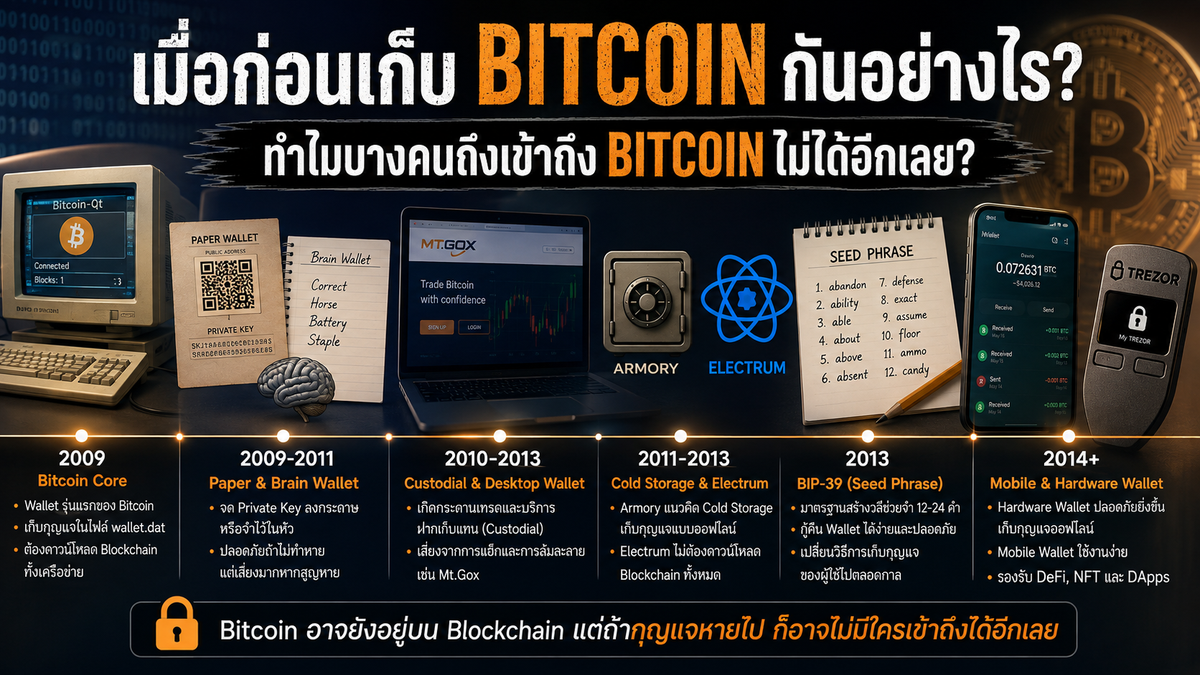
The early days of Bitcoin: Everything was on the computer
Bitcoin launched in 2009 alongside the first Bitcoin software. In the beginning, this software didn't have the user-friendly interface and systems of today's wallets. Users had to install programs on their computers and manage everything themselves.
Later, the software was developed and became known as Bitcoin-Qt, before changing to the name Bitcoin Core, as we know it today. The important thing is that wallets in that era relied on data stored on the computer.
One file that early Bitcoin users were very familiar with was named 'wallet.dat'.
This file contained crucial information related to the wallet and the keys used to control Bitcoin.
This meant that if any of the following occurred:
- The computer broke
- The hard drive failed
- The file was deleted
- The device was discarded
- Or the data was lost without a backup
The user could lose access to their Bitcoin.
Today, we might be used to writing a seed phrase on a piece of paper and storing it, but back then, backing up a wallet required much more technical understanding from the user.
And for those who didn't prioritize backing up their data, a single mistake could lead to losing access to their Bitcoin forever.
Paper Wallets: Keys written on paper
Another method that gained popularity in the early days was the Paper Wallet.
The concept was very simple: instead of storing the private key on the computer, users could print or write the vital information on paper and store it in a secure location.
The advantage was that the private key could be kept offline, not constantly connected to the internet.
But the disadvantage was just as straightforward: if the paper was lost, access to the Bitcoin was lost along with it.
Furthermore, paper is susceptible to fire, water, humidity, or accidental disposal. The paper wallet is thus a good example of storing Bitcoin in an era where users were almost entirely responsible for securing their own keys.

Brain Wallets: When some people tried storing Bitcoin in their memory
Another concept that "used to" garner interest was the Brain Wallet.
The name 'Brain wallet' might lead one to believe it involves memorizing the private key directly, but in reality, a brain wallet usually means using a phrase or password that the user can remember as the basis for generating a private key, such as memorizing 12-24 words.
The concept was:
No need to store files, no need to store paper; just remember that phrase, and you can recreate the original wallet.
Sounds very convenient, right? But the problem is that we cannot predict the future. Events might occur that make us unable to remember that phrase anymore, which means we would no longer be able to access those Bitcoins.
For this reason, Brain Wallets have become a high-risk method and are not recommended for use today.
As Bitcoin usage grew, so did the evolution of wallets
When Bitcoin started to become more widely known, people began looking for more convenient ways to use and store Bitcoin.
New types of wallets began to emerge to solve the problems early users had encountered.
One important example is Electrum.
Electrum allows users to use Bitcoin without needing to download the entire blockchain to their machine, making the wallet smaller and easier for the average user to access.
Another name is Armory, a wallet that emphasized storing Bitcoin securely and was one of the early software options that helped push the concept of 'Cold Storage'.
Cold storage means keeping the vital information needed to control Bitcoin in a way that isn't directly connected to the internet.
This concept helps reduce the risk of online attacks and became a crucial foundation for Bitcoin storage methods later on.
A major turning point: When backing up wallets became easier
One of the big problems for early-era wallets was the backup process. Users had to understand what vital information was, which files to back up, and how to store that information.
Later, the concept of HD Wallets (Hierarchical Deterministic Wallets) began to play a greater role.
The key concept of an HD wallet is that the wallet can generate many addresses and private keys from the same root source, making wallet management and backups much more convenient than early systems.
After that, in 2013, BIP-39 was proposed.
BIP-39 is a standard for creating a set of words that are easy for humans to read and write down, used as part of the process for creating and recovering deterministic wallets.
What we now call a seed phrase or recovery phrase,
became a format users were more familiar with. An important point to understand is that before BIP-39, Bitcoin users were still able to back up their wallets, but the process was usually not as simple as keeping a single set of wallet backups like modern wallets do.
Therefore, BIP-39 was not the point that "made wallet backups possible for the first time," but it was one of the key standards that helped make wallet backup and recovery easier and more standardized.
This is one reason why general users in later eras could manage their wallets much more conveniently than early Bitcoin users.
Mobile Wallets: When Bitcoin entered our phones
When smartphones became a part of everyday life, wallets started moving from computers to mobile phones.
Modern wallets also began utilizing the HD wallet concept more, allowing users to create multiple addresses from the same recovery information.
Backups are therefore much more convenient than in the past. Users don't need to worry about backing up individual private keys like in the early days because wallets can organize the key structure into a more systematic format.
Hardware Wallets: When private key storage moved off the computer
Although software wallets have become much more convenient, they still carry risks from malware or attacks on computers and mobile devices.
This is where hardware wallets began to play a role. One of the significant products in the industry is the Trezor Model One, which launched in 2014 and is cited by Trezor as the world's first hardware wallet.
The concept of a hardware wallet is to keep the private key inside a dedicated device instead of storing it directly on a computer or mobile phone.
When a user wants to make a transaction, the device helps manage the processes related to the private key without needing to expose that key directly to the computer.
This gave the average user a more convenient option for self-custody of Bitcoin, and when paired with wallet backups, backing up and recovering a wallet became much easier for the general public to understand than before.
From a wallet for storing coins to a wallet for using Web3
As blockchain began to evolve beyond just receiving and sending Bitcoin, wallets started to play an increased role. The advent of Ethereum and smart contracts allowed users to connect their wallets directly to blockchain applications.
Wallets were no longer just tools for receiving and sending coins but could also be used to connect to decentralized applications, or DApps.
A well-known example is MetaMask.
MetaMask is a non-custodial wallet that allows users to connect to various blockchain services via a browser, and it later expanded into mobile wallets as well.
This shift turned the wallet into a "key to the Web3 world."
So, why could early users never access their Bitcoin again?
Looking back at the history, the answer becomes clearer. In the early days of Bitcoin, managing a wallet required more user expertise than it does today.
Many people kept important data on:
- computers
- hard drives
- wallet files
- paper
- or self-managed backup methods
If the device broke, the file was lost, or no backup was made, access to the Bitcoin could be lost permanently.
The important thing is that those Bitcoins did not disappear from the blockchain. The Bitcoin is still there, but there is no longer a private key or backup information that can be used to control those Bitcoins.
The Bitcoin is still there, but the key to access it is what has been lost.
And this is the reason why some Bitcoin may still appear on the blockchain, but no one can access it anymore.
Lessons we can apply today
Even though wallets today are much easier to use than before, the fundamental principle of Bitcoin remains the same: if we are the ones holding the private key or wallet backup, we are the ones responsible for taking good care of it.
Keep your wallet backup safe
Recovery information for a wallet should be stored in a safe, private location, protected against damage from unexpected events. Since recovery information provides access to assets, it should never be revealed to others or stored in an online format.
Verify your backup
Having a wallet backup with typos or incomplete information may make it impossible to restore the wallet. You should ensure that your backup information is accurate and complete, and understand the recovery process for the wallet you are using.
Choose a storage method that suits you
For those who want to hold assets themselves for the long term, a hardware wallet is one option that helps isolate the private key from computers and mobile phones. However, regardless of the wallet chosen, the most important thing is understanding:
Who holds the keys, and can we recover our own wallet?
Summary
The story of Bitcoin where access was lost in the early days did not happen because Bitcoin disappeared from the blockchain.
Rather, it often occurred because methods for storing and backing up keys were not as convenient as they are today, along with human errors that can happen to anyone.
From an era where users had to manually back up wallet.dat files, through paper wallets and brain wallets, to the era of HD wallets, wallet backups, and hardware wallets, technology has made storing and recovering wallets much easier.
But there is one thing that has not changed.
If we are the key holders, we must take responsibility for those keys ourselves.
Bitcoin on the blockchain may not go anywhere, but if the access information is lost and no backup remains,
those Bitcoins may become assets that remain on the blockchain but can no longer be controlled by anyone. That is a significant lesson that early Bitcoin holders have left for all of us.
Frequently Asked Questions about Bitcoin Wallets
Is Bitcoin actually in the wallet?
No. Bitcoin is not stored directly inside the wallet; ownership information is recorded on the blockchain. The wallet's duty is to manage the keys and information used to control the user's Bitcoin.
If I lose my hardware wallet, is my Bitcoin gone?
Not necessarily. If you still have a correct wallet backup that can be used with supported systems, you can restore access to the wallet.
What is a seed phrase?
A seed phrase, or wallet backup, is a set of words used as vital information for recovering a wallet in systems that support the standard, such as BIP-39. BIP-39 was proposed in 2013 to create a mnemonic format that is easier for humans to read and record.
What happens if the seed phrase is lost?
If a user has no other backup method or recovery information, losing the seed phrase may make it impossible to restore access to the wallet.
Why is Bitcoin with a lost private key still on the blockchain?
Because Bitcoin is not deleted from the blockchain just because the owner lost the key. However, if there is no private key or information to control that Bitcoin, it is impossible to create a transaction to move it.

แชร์:
I've bought a hardware wallet, what's next? A beginner's checklist from unboxing to transferring your first coins.
Understanding Hardware Wallets and Seed Phrases: A generational comparison.