


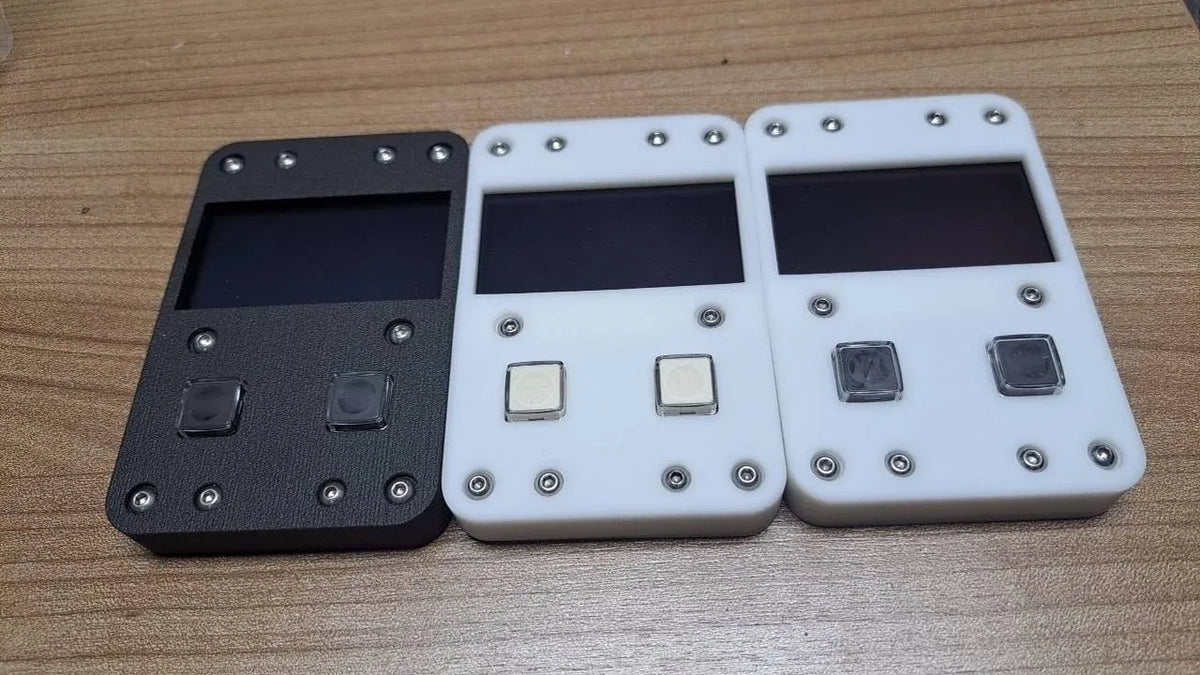
If you self-custody Bitcoin, you've probably encountered this question: what's inside the hardware wallet you're using, and how much can you verify?
For most devices on the market, the answer is "not much." The firmware might be open, but the chip holding your keys is usually a closed-source secure element. You can't inspect what's running inside; you just have to take the manufacturer's word for it.
PHYLAX is an attempt to answer that question differently. This Bitcoin-only, open-source hardware wallet is being built in Thailand, and the team is publishing every step of the process transparently from day one — including when things break.
What is it?
As of now, the PHYLAX hardware wallet is a prototype, aiming for a Q4 2026 launch. Here’s what’s inside:
- STM32F205RET6 microcontroller — ARM Cortex-M3, 120 MHz, 1 MB Flash
- 2.42-inch OLED display, SSD1309 controller, 128 × 64 resolution
- No secure element; keys are stored on the microcontroller running readable firmware
- No battery; powered solely via USB cable
- No wireless connectivity; no Bluetooth, no Wi-Fi, no NFC
- Standard, unmodified Trezor Model One firmware
- Buttons rated for 500,000 clicks
- Firmware is GPL v3 · Hardware is CERN OHL-S v2
The full list, along with a bill of materials, is available on the specifications page.
Why no secure element?
This is arguably the most controversial design decision, and the PHYLAX team candidly lays out its downsides themselves:
A certified secure element is indeed harder to attack if the attacker has physical possession of the device and laboratory-grade tools. That's a fact, not debatable.
What the open approach gives back is verifiability: firmware you can compile yourself and hash-check against the device, circuitry you can read, and no component whose behavior depends solely on the manufacturer’s word.
It's a trade-off, not a free lunch. The fact that they articulate the downsides themselves, rather than letting others point them out, says something about how this team operates.
More interestingly: creating your seed with a coin
One thing that open source cannot solve is randomness.
You can read the firmware, compile it yourself, and check its hash, but you cannot read randomness. A compromised random number generator will produce perfectly normal-looking results — correct length, correct checksum, valid word list — and there is no way to tell by visual inspection.
PHYLAX is developing an option for users to feed in their own randomness by flipping a coin. One fair coin flip yields exactly one bit, so 256 flips give you the full 256 bits for a 24-word seed. The device will then mix that value with its own hardware randomness. The result is thus at least as unpredictable as the better of the two sources.
This means if the device's random number generator is compromised, your coin saves you. And if you flip your coin haphazardly, the hardware saves you. Neither party needs to be trusted alone.
Rare sincerity: they publish when it breaks, too
The PHYLAX build log is 18 entries long and doesn't just feature good news.
- Update 03 reports that the first case was too large.
- Update 10 reports that USB is not yet working.
- Update 13 reports that the display is fixed, but two new issues arose — the power circuit hums, and USB only works when the cable is plugged in one way.
- Update 16 explains the culprit was a 9-pin USB-C port header that provided only one pair of data lines.
And on the specifications page, there are three rows marked "planned" — components that have been decided upon for replacement but are not yet on the board. They explicitly state, "We could just list the parts we intend to use at launch and let you assume they’re already on the board," but chose not to.
For a device that asks you to entrust it with your money, this kind of habit is more important than a flashy spec sheet.
Where to follow along
The prototype will be showcased at the Bitcoin Thailand Conference 2026.
- Thai website: phylaxwallet.com/th
- Full specifications: phylaxwallet.com/th/specs
- Build log: phylaxwallet.com/th/journal
- Behind the idea: Manifesto


แชร์:
เก็บ Seed Phrase ด้วยการ "จำ" แทนการ "จด" ปลอดภัยจริงหรือแค่รู้สึกปลอดภัย?
Liquid Network มีปัญหา! กระทบกับผู้ใช้งาน Hardware Wallet หรือไม่?