


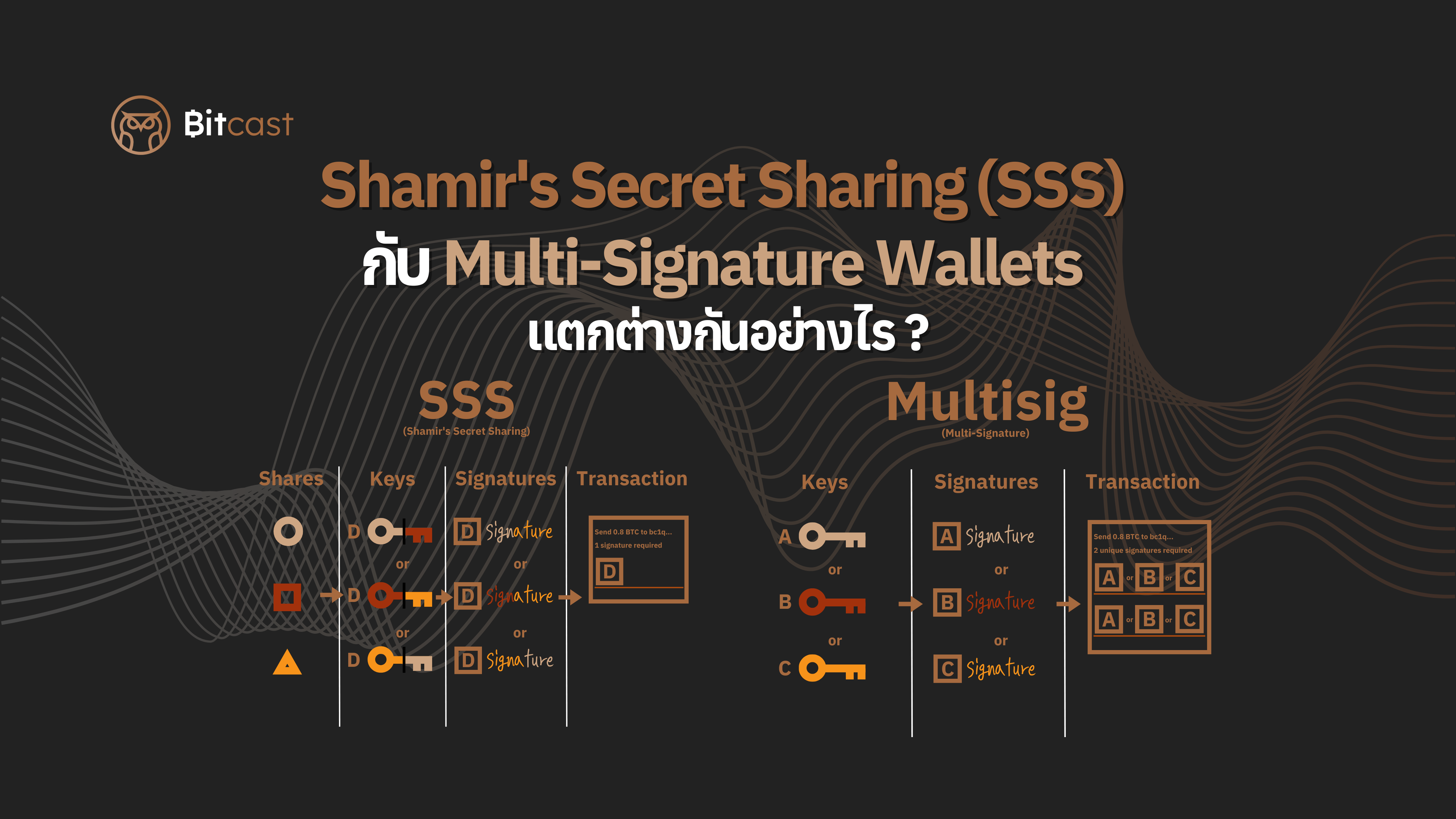
In the world of cryptocurrencies and digital security, two important concepts are often discussed when it comes to securely managing digital assets: Shamir's Secret Sharing (SSS) and Multi-Signature Wallets (Multi-sig wallets). Both methods aim to enhance the security of asset access but operate on different principles. This article will explain in simple terms what each method is and how they differ.
What is Shamir's Secret Sharing (SSS)?
Imagine you have a critical key (Secret) that opens a safe containing your valuable assets, but you fear that if this key is lost or stolen, you will lose everything. Shamir's Secret Sharing, or SSS, is a technique designed to solve this problem.

SSS is a cryptographic algorithm designed to split a "secret" (such as a crypto wallet's private key) into several parts, known as "shares." The key principles of SSS are:
- Divided into multiple parts: You can split the secret into any number of shares, such as 3, 5, or more.
- Minimum number required for recovery: The interesting thing is that you don't need all the shares to recover the secret. You can set a "threshold" number that is necessary. For example, if you split the secret into 5 shares, you might specify that only 3 of any of those shares are needed to recover the secret.
- Individual shares are meaningless on their own: Each divided share is meaningless on its own. This means that even if someone obtains one or two shares, but not the specified threshold number, they cannot recover the secret.
Example: You have a Bitcoin Wallet Private Key that you want to protect. You use SSS to split the Private Key into 5 shares and set a recovery threshold of 3 out of 5 shares. You might keep share 1 with yourself, share 2 with a close friend, share 3 with your lawyer, share 4 in a bank safe deposit box, and share 5 at your parents' house. If you need to access your Private Key, you simply gather any 3 shares to reconstruct it.
What are Multi-Signature Wallets (Multi-sig wallets)?
Multi-Signature Wallets, or Multi-sig wallets, are crypto wallets that require signatures from multiple individuals or multiple keys to approve a transaction. The operation of Multi-sig is similar to financial transactions that require approval from several executives.

- Requires multiple signatures: Instead of using a single Private Key to approve transactions, a Multi-sig Wallet specifies that multiple Private Key signatures are required to approve a transaction.
- Specifies the number required: You can configure how many signatures out of the total are needed. For example, "2-of-3 Multi-sig" means that 2 signatures from a total of 3 Private Keys are required to approve a transaction.
- Increases security and reduces risk: Multi-sig is highly beneficial for enhancing the security of your funds. If one Private Key is stolen, or one person passes away, the entire fund cannot be controlled.
Example: You own a company that wants to hold funds in Bitcoin but doesn't want any single executive to be able to withdraw money unilaterally. You set up a 2-of-3 Multi-sig Wallet, meaning there are 3 Private Keys (each held by one executive), but at least 2 executives must sign to approve a transaction before funds can be transferred out.
Key Differences: SSS vs. Multi-sig Compared Visually
To illustrate the differences more clearly, let's consider these hypothetical scenarios.
Scenario 1: Opening a Safe (SSS)
Imagine you have a large safe containing your most valuable possessions (analogous to your Private Key).
-
If using SSS: You create one master key (Private Key), but instead of keeping the whole key to yourself, you use SSS to "break" that key into 5 pieces (like breaking the key into 5 segments). You specify that any 3 pieces are needed to reconstruct the key and open the safe.
- You might give piece 1 to your parents.
- Piece 2 to your lawyer.
- Piece 3 to a close friend.
- Piece 4 stored in a bank.
- And piece 5 kept at home.
- Objective: This is done to prevent the entire key from being lost or stolen all at once. If someone only gets 1 or 2 pieces, they cannot open the safe. You can recover the key to open the safe when you actually need it (e.g., to transfer crypto) by collecting the specified number of pieces.
Scenario 2: Approving a Withdrawal from a Company Account (Multi-sig)
Suppose you own a company, and you have a company bank account with 3 executives who have the authority to withdraw money.
-
If using Multi-sig: You specify that to withdraw money from the company account, at least 2 out of 3 executives must sign the check or withdrawal document.
- Executive 1 has their own signature (analogous to Private Key 1).
- Executive 2 has their own signature (analogous to Private Key 2).
- Executive 3 has their own signature (analogous to Private Key 3).
- Objective: This is done to prevent any single executive from unilaterally withdrawing money, or if one executive acts fraudulently or an unforeseen event occurs (e.g., death), the remaining executives can still process withdrawals when the required number of signatures is met. This controls "transaction authority."
Comparison Table
|
Feature |
Shamir's Secret Sharing (SSS) |
Multi-Signature Wallets (Multi-sig) |
|
Analogy |
Breaking a single master key into multiple pieces to prevent loss or theft. |
Specifying the number of signatures required to approve funds usage in a company account. |
|
Primary Purpose |
Recovering the "key" (Private Key) to access assets. |
Approving "spending" (transactions) with the involvement of multiple parties. |
|
How it works |
Combining shares to reconstruct the original key when needed. |
Each person signs to allow the transaction to proceed; keys are not combined into one. |
|
What it protects against |
Prevents the loss or theft of the entire key. |
Prevents control of all funds by a single individual or unilateral transactions. |
Concise Usage Methods
Now that you understand the differences, let's look at concise usage methods for each.
How to Use Shamir's Secret Sharing (SSS)
- Choose a tool/software: Use a program or library that supports SSS (e.g., sss-cli or libraries in various programming languages).
- Define the secret: Specify the Private Key or critical information you want to share.
- Set the number of shares (N) and threshold (K): Decide how many shares (N) you want to split the secret into and how many shares (K) are needed for recovery, where K≤N.
- Create shares: Use the SSS tool to generate N shares from your secret.
- Distribute/store shares: Securely distribute these shares to different storage locations or individuals. Do not keep all shares in the same place.
- When recovery is needed: Gather K shares and use the SSS tool to reconstruct the original secret.
How to Use Multi-Signature Wallets
- Choose a platform/wallet that supports Multi-sig: Use a crypto wallet that supports Multi-sig functionality (e.g., Gnosis Safe, Electrum, Sparrow Wallet for Bitcoin, or some DeFi Protocols).
- Set the total number of keys (N) and required signatures (M): Decide how many Private Keys (N) can control the wallet and how many signatures (M) are needed to approve a transaction, where M≤N (e.g., "2-of-3" means M=2, N=3).
- Create or import Private Keys: Each individual who will be a signatory will have their own Private Key.
- Set up the Multi-sig Wallet: Create a Multi-sig Wallet on your chosen platform by adding the Public Keys of all N Private Keys and specifying the required number of signatures M.
- Transact: When transferring coins or performing any transaction, the controllers must:
-
- Create the transaction.
- Each person with a Private Key must "sign" that transaction.
- Once the required M signatures are obtained, the transaction will be sent to the network and processed.
Conclusion
The choice between SSS and Multi-sig depends on your specific security objectives and needs. SSS is suitable for recovering "secrets" that are private keys, while Multi-sig is ideal for controlling "transaction approvals" with the involvement of multiple parties.
For those seeking the highest level of security for digital assets, a Hardware Wallet is an excellent choice. It stores your Private Keys offline, significantly reducing the risk of hacking or malware.
The Importance of Hardware Wallets for SSS and Multi-sig
- With SSS: Some Hardware Wallets can work with SSS by serving as one of the shares of the secret or assisting in the Private Key recovery process to reconstruct the secret.
- With Multi-sig: Hardware Wallets play a crucial role in Multi-sig Wallets, as each signatory can store their Private Key in a separate Hardware Wallet. This ensures that these keys are secure and allows them to safely sign transactions from their own devices.
For assurance of quality and after-sales service, Bitcast is an official distributor of Hardware Wallets in Thailand, allowing you to purchase certified and quality-guaranteed products directly.


แชร์:
Tangem VS Tapsigner: The Battle for the Hardware Wallet Card Crown! Which one is right for you?
iOS vs. Android: Mobile Crypto Security Issues You Should Know About