


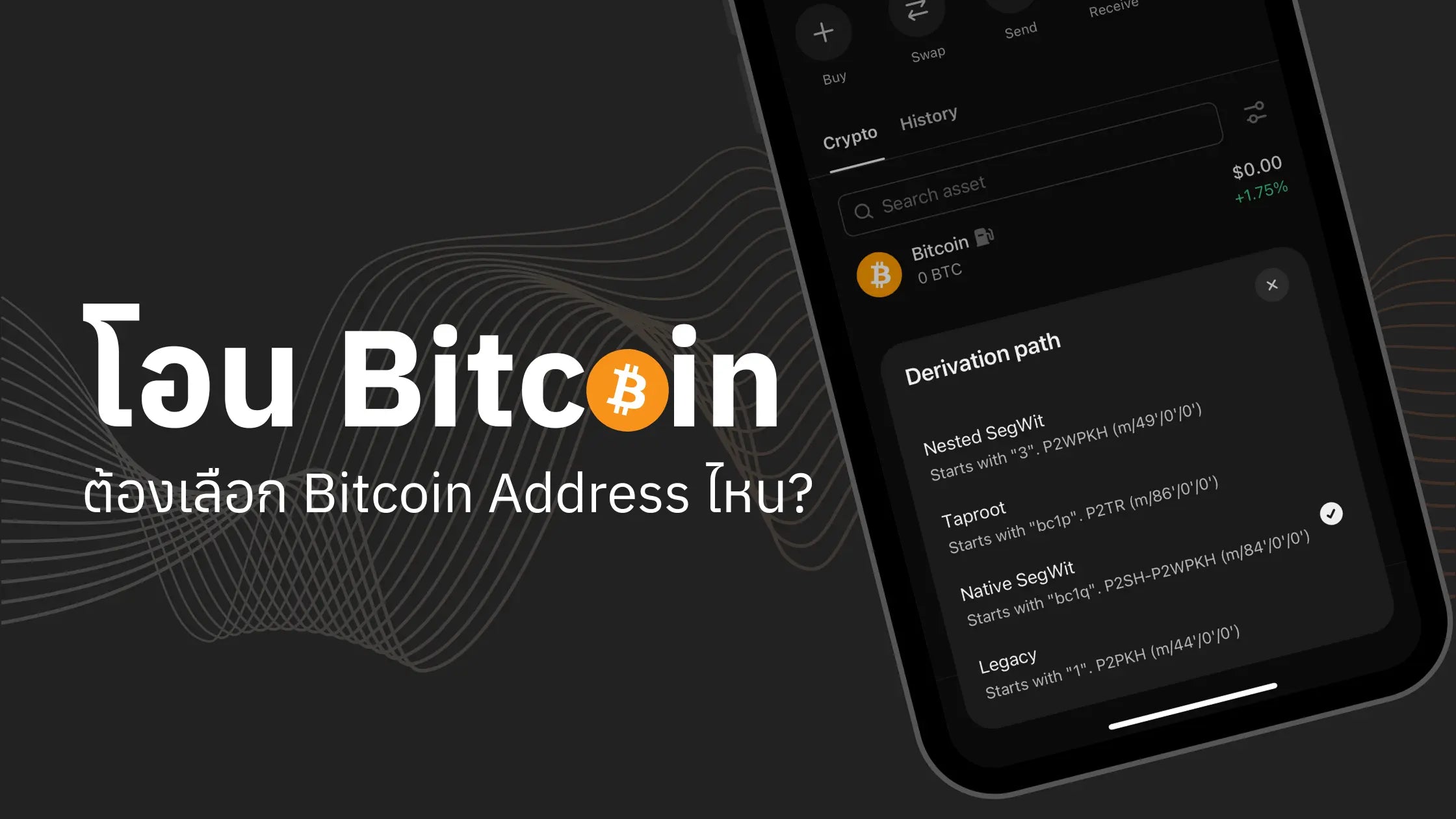
Many new users have questions about transferring Bitcoin to a Hardware wallet, and they often ask, "Which Bitcoin Wallet Address type should I choose?" (from the image above) and "How do they differ?" This article will introduce you to each type of Bitcoin Wallet Address and guide you on how to choose the right one for your needs.
What is a Bitcoin Address?
A Bitcoin Address is a set of alphanumeric characters that specifies the unique destination for a Bitcoin transaction. It typically starts with "1", "3", or "bc1" and is case-sensitive. These addresses serve as unique identifiers for recipients, enabling secure sending and receiving of Bitcoin through a decentralized network.
Bitcoin addresses are based on a pair of Public and Private Keys. The Public Key is hashed and encoded into a shorter, more manageable format for use as an address. It is used to prove ownership of received funds and record transactions on the blockchain.
These addresses are essential for verifying and confirming transactions within the Bitcoin network. They also provide users with a degree of privacy, as they do not reveal personal information such as the owner's name or other addresses.
Types of Bitcoin Addresses
Different types of Bitcoin Address formats
Bitcoin addresses come in several versions due to the evolving technology of Bitcoin and the need to support various functionalities while maintaining compatibility with existing systems. They are interoperable, meaning different versions can send to each other. Currently, there are four main types:
1. Legacy (P2PKH)
The original and widely used Bitcoin Address format. It is encoded using Base58, which excludes easily confused characters. Addresses starting with "1" use the Pay-to-Public-Key-Hash (P2PKH) script type and are case-sensitive, for example, "15e15hWo6CShMgbAfo8c2Ykj4C6BLq6Not".
These Bitcoin addresses are straightforward for sending and receiving Bitcoin as they are generated by hashing the recipient's Public Key. Legacy Bitcoin addresses have broad compatibility as most wallets and exchanges support them.
SegWit (P2SH)
SegWit was introduced to upgrade the Bitcoin network for better scalability, such as the Lightning Network. There are two types of SegWit Bitcoin addresses:
2. Nested SegWit (P2SH format)
This type addresses network scalability issues. Bitcoin addresses starting with "3", for example, "3J98t1WpEZ73CNmQviecrnyiWrnqRhWNLy" are based on the Pay-to-Script-Hash (P2SH) script type and use Base58 encoding.
Similar to Legacy Bitcoin addresses, they are case-sensitive.
3. Native SegWit (Bech32 format)
Addresses starting with "bc1", for example, "bc1qar0srrr7xfkvy5l643lydnw9re59gtzzwf5mdq", offer low transaction fees and the most efficient use of block space.
Compared to the P2SH format, the Bech32 format uses only lowercase characters, has better error detection, and is more human-readable. It is suitable for new services and applications that want to leverage the full capabilities of the Bitcoin network and promote the adoption of SegWit technology.
4. Taproot (P2TR)
Taproot (P2TR: Pay-to-Taproot) or Bech32m format is the latest and most future-proof format. These Bitcoin addresses are not case-sensitive and start with "bc1p", for example, "bc1p5d7rjq7g6rdk2yhzks9smlaqtedr4dekq08ge8ztwac72sfr9rusxg3297".
Taproot was implemented on the Bitcoin network in November 2021 and brought several improvements. One of the key upgrades was the integration of Schnorr signatures and Merkle trees. These technologies allow Taproot addresses to combine multiple scripts into a single output, reducing transaction size and increasing privacy because more complex transactions will appear as simple transactions on the Bitcoin blockchain.
Furthermore, the Taproot protocol enables the creation of digital assets on Bitcoin, allowing for the development of Ordinals (NFTs) and other tokens on the Bitcoin network.
Summary table of differences between each type of Bitcoin Address
|
Address Type |
Prefix |
Transaction Size |
Fees |
Compatibility |
|
Legacy (P2PKH) |
1 |
Larger transaction size, using more block space |
Higher fees than SegWit |
Compatible with all Bitcoin wallets |
|
Nested SegWit (P2SH) |
3 |
Smaller size, or if the same size as Legacy, uses less block space |
Lower fees than Legacy |
Most wallets |
|
Native SegWit (P2WPKH) |
bc1 |
Reduced transaction size and fees. Addresses only use lowercase characters, with improved error detection. |
Lower fees than Nested SegWit |
Most wallets |
|
Taproot (P2TR) |
bc1p |
Reduced transaction size and increased privacy. |
Lowest fees |
Limited support |
You can watch a video on how to choose a Bitcoin Address here:
Which Bitcoin Address should you choose?
When choosing a Bitcoin wallet address, consider the following factors:
1. Compatibility
Ensure that the address type you choose is supported by your wallet and any exchange platforms you plan to use.
2. Transaction Costs
Choose an address type that minimizes transaction fees, with Native SegWit often being the best option.
3. Future Support
As Bitcoin technology evolves, newer address formats like Taproot may offer advantages in terms of privacy and functionality.
Recommendations for New Users
For those new to Bitcoin:
- Start with a wallet that uses Native SegWit (bc1q) addresses by default.
- Avoid using Legacy addresses unless absolutely necessary.
- Explore Taproot-compatible wallets if you are interested in future features.
FAQ for transferring Bitcoin to a Hardware Wallet
Q: Can different Bitcoin address types transfer to each other?
A: Yes, all types can transfer to each other, for example, a Legacy address can transfer directly to a Native SegWit address.
Q: When transferring Bitcoin from an Exchange to a Hardware Wallet, which network should I choose?
A: Choose the Bitcoin Network only. Bitcoins on other networks, such as BNB Smart Chain or Arbitrum, which have lower transfer fees, are not real Bitcoin. They are similar to holding Bitcoin tickets or WBTC. If you want to accumulate real Bitcoin, only transfer using the Bitcoin Network.
Conclusion
Understanding the different types of Bitcoin addresses is crucial for efficient digital currency management. Choosing the appropriate Bitcoin Address type, considering compatibility, transaction costs, and future needs, will help users enhance their experience within the Bitcoin ecosystem.
For new users, it is recommended to choose a Native SegWit Bitcoin Address, as it offers the best balance between efficiency and compatibility.
References:
[1] https://leather.io/guides/bitcoin-address-types
[2] https://anitaposch.com/bitcoin-address-formats
[4] https://bitbox.swiss/blog/what-are-bitcoin-address-types/
[5] https://cointelegraph.com/learn/types-of-bitcoin-addresses
[6] https://unchained.com/blog/bitcoin-address-types-compared/


แชร์:
Invest in Bitcoin with DCA for disciplined wealth creation in 2024
4 Interesting Bitcoin Wallets in 2024
1 comment
ขอบคุณสำหรับข้อมูลดีๆครับ