


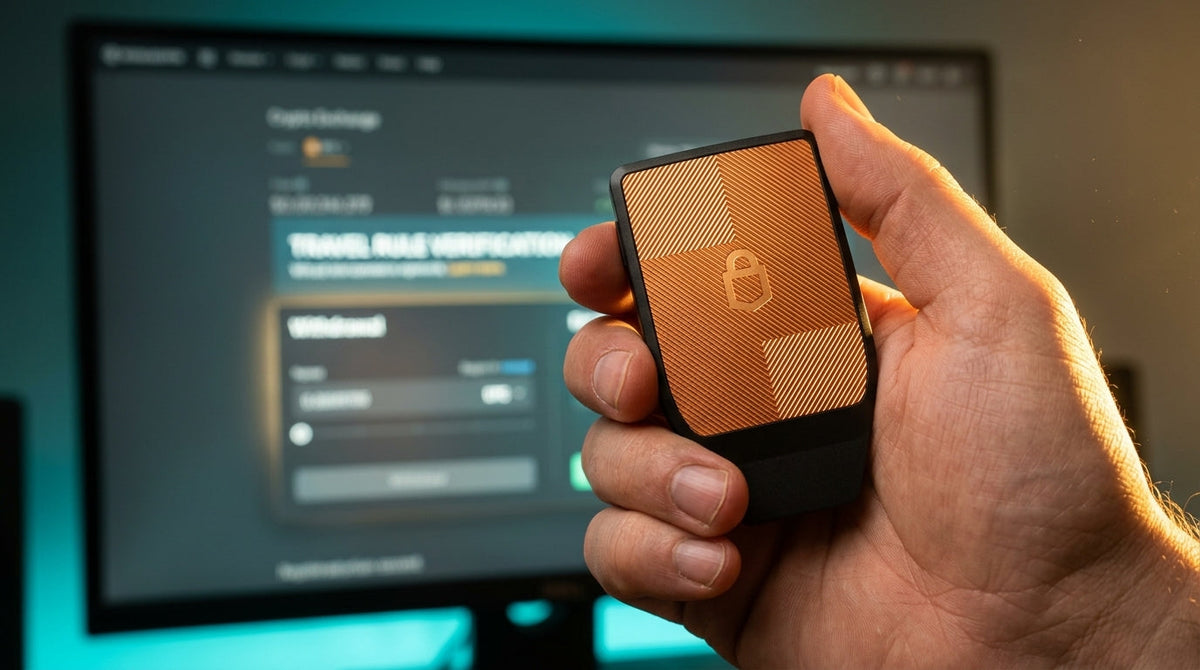
- Understanding the Facts of the Travel Rule: Is it a "Ban" or just "Monitoring"?
- Scope of Regulation: Controls only intermediaries, doesn't affect our wallets
- Normal usage on exchanges remains unaffected
- So, should we be afraid of buying Bitcoin from now on?
- The Bitcoin blockchain continues to operate independently
- Lessons from abroad: When the Travel Rule becomes commonplace
- How much should we transfer: "less than 30,000" vs "more than 30,000 baht"? Which is better?
- The "Structuring Risk" many people don't know about
- The silent threat of network fees and dust UTXOs
- Consolidating transfers over 30,000 baht: The most transparent and cost-effective option
- Clarifying concerns: "Fear of being tracked - fear of them knowing how much I have." Is it true, and what is the reality?
- Sincerity and honesty: We follow the law, there's nothing to fear.
- What they know vs. what they don't know
- And if we transfer from wallet 1 to wallet 2, will they know it's us?
- Simple and correct privacy management methods
- Comparison table: Leaving funds on the exchange vs. taking the time to verify and self-custody
- Admin's opinion: Why does the Travel Rule further emphasize the value of "Financial Sovereignty"? 🏛️
- Key takeaway: Even if they know, they have no right to compel or seize our money
- A few minutes of inconvenience for a lifetime of financial freedom
- Practices that make Bitcoin storage easy and secure
- Summary
- Frequently Asked Questions (FAQ)
- Q1: If I don't want to verify wallet ownership, can I still withdraw Bitcoin from the Exchange?
- Q2: Does the Travel Rule make transferring Bitcoin between Hardware Wallets illegal?
- Q3: Will the identity verification data we submit to the Exchange be publicly disclosed on the blockchain?
Since the news that the Travel Rule officially came into force in Thailand, a new wave of anxiety has spread among crypto investors and Bitcoin enthusiasts.
Many people have started to hesitate when they see the increasingly complex process of withdrawing coins from exchanges, which involves verifying the destination wallet (Proof of Ownership / Whitelist). This has led to a common question popping up in many people's minds:
"If withdrawing coins is this difficult, should I just leave my Bitcoin on the exchange as before?"
"And if I confirm my wallet, will the authorities or the exchange be able to see all the coins I have?"
"Or should I really just be so scared that I stop buying Bitcoin altogether?"
Today, the admin will take everyone to delve into the facts, cut through the surrounding noise (FUD), and analyze the technical and philosophical perspectives of asset ownership so that friends can understand the overall picture and confidently decide where our money should be kept.
You can read the full article on the Travel Rule at Summary of Travel Rule for Thai Crypto: 30,000 Baht Transfer Criteria and Impact on Self-Custody
Understanding the Facts of the Travel Rule: Is it a "Ban" or just "Monitoring"?
Before making any decisions, we must first clearly establish the legal facts about what this law requires of us.
Scope of Regulation: Controls only intermediaries, doesn't affect our wallets
The key principle of the Travel Rule enforced by the SEC and AMLO is derived from the international standard FATF Recommendation 16, which addresses anti-money laundering (AML/CFT) and counter-terrorist financing.
- What the law controls: The regulations apply only to "digital asset business operators (VASPs / Exchanges)" licensed in Thailand, requiring exchanges to collect and transmit sender and receiver information when coins are transferred in and out.
- What the law does not do: The law "does not ban" and "does not prohibit" holding personal wallets (Unhosted / Self-Custody Wallets). All citizens still have the legitimate right to hold private keys and transfer Bitcoin to store in Hardware Wallets as usual, 100%.
Normal usage on exchanges remains unaffected
The Travel Rule will only take effect during the "moment of coin transfer to or from an Exchange's system." If you continue to buy and sell coins on the exchange or deposit and withdraw Thai Baht to your bank account, everything will continue to function smoothly as before.
So, should we be afraid of buying Bitcoin from now on?
When a new law is introduced, rumors and threats always spread faster than facts. But if we look at it rationally, we will find these two truths:
The Bitcoin blockchain continues to operate independently
Laws and regulations can only govern the "connection points (On/Off Ramps)" between fiat currency systems and crypto. However, laws cannot modify code, interfere with the blockchain, or halt the operation of the decentralized Bitcoin network worldwide.
Bitcoin continues to produce new blocks every 10 minutes precisely, and it remains a currency with a strict limited supply of 21 million coins (Absolute Scarcity), operating on mathematical principles as before.
This does not change the fact that the "right" to own money is still ours. No one has the right to control our money as before.
Lessons from abroad: When the Travel Rule becomes commonplace
Thailand is not the first country to implement this rule. Major global financial centers have been enforcing the Travel Rule for personal wallets for many years.
- Switzerland (FINMA): Has been in force since 2019, requiring verification of the destination wallet. However, Switzerland remains a hub for the Bitcoin industry, and people widely hold Hardware Wallets.
- European Union (EU TFR): During the drafting of the law, politicians attempted to propose a ban on personal wallets, but the European Parliament ultimately voted down that proposal as it violated the fundamental rights of citizens.
- South Korea (FSC): Has enforced a Whitelist system since 2022. Korean investors continue to buy and transfer coins to cold storage as a routine practice.
Therefore, the existence of the Travel Rule is not the end of buying Bitcoin, but merely a rule for financial institutions connecting to the crypto world.
How much should we transfer: "less than 30,000" vs "more than 30,000 baht"? Which is better?
With the transfer threshold set at 30,000 Baht (which is converted from the international standard of 1,000 USD/EUR), many people have an idea: "Then I'll split my transfers into multiple rounds of 28,000 or 29,000 Baht each, so I don't have to fill out information or go through checks?"
The admin wants to tell you upfront that this method is the most dangerous and disadvantageous, for these two reasons:
The "Structuring Risk" many people don't know about
In anti-money laundering law, the act of intentionally breaking large sums of money into smaller amounts to evade reporting requirements is called Structuring or Smurfing.
All exchanges have an automated Transaction Monitoring System. If the system detects that your account frequently makes transfers close to 30,000 Baht, it will immediately flag it. The consequences are:
- Temporary suspension of withdrawals: You will be required to submit documents explaining the source of your wealth and answer many more detailed questions than a normal wallet verification.
- Suspicious Transaction Report (STR): Exchanges are legally obligated to report this behavior to the Anti-Money Laundering Office (AMLO).
The silent threat of network fees and dust UTXOs
The Bitcoin system works with UTXOs (Unspent Transaction Outputs), which are like small banknotes in a wallet. Bitcoin transfer fees are not calculated by the amount of money, but by the data size in the block (Virtual Bytes: vB).
- If you split transfers into small amounts, you will incur multiple withdrawal (network) fees.
- Your wallet will be filled with dozens of small coin fragments. In the future, when you want to transfer money out, the wallet will have to combine all these fragments, making the transaction size very large and incurring exorbitant network fees on congested blockchains.
Consolidating transfers over 30,000 baht: The most transparent and cost-effective option
Accumulating coins into a large sum and then withdrawing over 30,000 baht at once, along with verifying wallet ownership completely, is the best option because:
- Only one transfer fee is incurred.
- You receive a single large UTXO in your wallet, saving on future transfer fees.
- The transaction is transparent and compliant with the law, without any risk of account suspension or suspicion.
Clarifying concerns: "Fear of being tracked - fear of them knowing how much I have." Is it true, and what is the reality?
This is the biggest concern for those who value privacy. Let's break down the technical realities and systemic truths, layer by layer.
Sincerity and honesty: We follow the law, there's nothing to fear.
Before delving into technical matters, I'd like to invite everyone to adjust their perspective here: "If we buy Bitcoin with honestly acquired funds and conduct transactions legally, we have no need to worry or try to hide anything." Even if we don't agree with this rule, it doesn't mean we have to try to do something wrong or try to be something we're not.
In the real world, if the government wants to examine someone's financial trail, they can already request trading information from the Exchange where we completed KYC. They already know from the first moment how much Thai baht we transferred in and how many bitcoins we bought. Therefore, trying to zigzag transfers on the blockchain makes little significant difference in terms of scrutiny.
What they know vs. what they don't know
When you submit your wallet verification information to an Exchange:
- What they know: The Exchange already knows how much Bitcoin you bought and that this sum of money was transferred to this specific destination address (Receiving Address).
- What they don't know: Modern Hardware Wallets operate according to the HD Wallet standard (BIP-32), which can generate millions of receiving addresses from a single seed phrase. When you send one address to the Exchange, the system only sees the balance of that specific address. They do not receive your Master Public Key (xPub), so it is mathematically impossible for them to know how many other addresses you have or the total amount of coins stored on your device.
And if we transfer from wallet 1 to wallet 2, will they know it's us?
Many people suggest, "So, after withdrawing to wallet 1, transfer it to wallet 2 to break the connection." I'll explain this based on the principles of on-chain analysis:
- On wallet 2, your name isn't actually attached: Legally, this offers plausible deniability because the blockchain has no way of knowing if wallet 2 belongs to you or if you transferred it to pay a friend.
- However, data analysis algorithms can deduce connections: Blockchain analytics companies have tools that monitor transfer patterns. If all coins are transferred directly from 1 to 2, the system will often infer that they belong to the same owner.
- The connection will be 100% re-established: If one day you transfer coins from wallet 2 back to an exchange with KYC, or combine coins from wallet 1 and 2 in a single transaction (co-spending), all historical data will immediately be linked back to your name.
Summary of this point: Simple zigzag transfers from 1 to 2 do not help erase traces on the public ledger and will only cause you to incur double network fees unnecessarily.
Simple and correct privacy management methods
Instead of zigzag transfers, use these basic secure methods:
- Always use a Fresh Address: Every time you withdraw coins from an exchange, use a new address that has never been used before. Standard hardware wallet apps generate these automatically.
- Clearly separate savings wallet roles: Let your Hardware Wallet function as a "Vault," meaning its sole purpose is to receive and securely store your savings. Do not transfer coins from your vault for casual transactions, small purchases, or P2P transfers with strangers, to avoid unnecessarily linking your transaction history to external entities.
Comparison Table: Leaving Funds on the Exchange vs. Taking the Time to Verify and Self-Custody
To provide the clearest picture, I've summarized a head-to-head comparison across 5 key dimensions:
| Comparison Dimension | Leaving Coins on the Exchange | Verifying Wallet and Transferring to Hardware Wallet |
|---|---|---|
| 1. Trading Convenience | Very convenient, ready to sell or exchange for Thai Baht immediately. | Must transfer back to the exchange before selling. |
| 2. Ownership Rights | Not the true owner, merely a creditor of the exchange. | 100% absolute owner (Not your keys, not your coins). |
| 3. Counterparty Risk | Very high. If the exchange goes bankrupt, is hacked, or undergoes maintenance, you could lose all your funds. | No counterparty risk. Assets are under the control of the keys you hold. |
| 4. Risk of Account Freezing | At risk. Accounts may be locked or withdrawals suspended as per regulatory orders. | No one can freeze it, as long as you keep your Seed Phrase secure. |
| 5. Data Privacy | All data and investment portfolios are recorded in the company's database. | The exchange only knows the amount you withdrew, but cannot view your total balance in your wallet. |
Admin's Opinion: Why Does the Travel Rule Further Emphasize the Value of "Financial Sovereignty"? 🏛️
Through a superficial lens, the Travel Rule might seem like an added burden and a reduction in privacy. However, looking deeper, I believe this rule serves as the most powerful mirror reflecting reality.
The Core Principle: Even if they know, they have no right to force or freeze our money.
The most important thing I want everyone to realize is not whether "they know or don't know we have Bitcoin," but the true decisive point is: "Even with any law, or even if they know, they have no right, no button, and no power in the world to order our funds frozen, seized, or to prevent us from transacting."
Let's imagine a comparison:
- If your money or Bitcoin remains on an exchange, one day there might be a new policy, a suspension order, or system maintenance, and your assets will be locked immediately without you being able to do anything. This is because it is "Permissioned Money."
- But as soon as you transfer your coins to your own Hardware Wallet, you change your status from a "creditor of the exchange" to a "100% absolute owner" on a network with an absolute scarcity of 21 million coins. You have complete Financial Sovereignty.
A few minutes of hassle for lifelong financial freedom.
Confirming wallet ownership (Proof of Ownership) might take an extra 3–5 minutes the first time, but those few minutes of hassle are a highly worthwhile price to pay for eliminating counterparty risk forever.
History has taught us repeatedly, from Mt.Gox and FTX to exchanges in our own country, that those who leave their coins on exchanges because they think it's "convenient" always end up learning the most expensive lessons of their lives.
Practical Guidelines for Easy and Secure Bitcoin Storage
For friends who want to accumulate and hold Bitcoin with peace of mind in the era of the Travel Rule, I recommend these 3 simple guidelines that you can apply immediately:
- Accumulate gradually (DCA) on the exchange, then withdraw in one lump sum (Batching): Diligently DCA and buy coins according to your plan. Let the accumulated balance grow to a significant amount (e.g., exceeding 30,000 baht or at the end of the month), then withdraw it all at once. This method will save a massive amount on network fees and avoid creating unnecessarily fragmented transaction history.
- Consistently receive coins with a Fresh Address: Utilize the standard function of a Hardware Wallet, which always generates a new receiving address for you, to maintain order and reduce data linkage on the blockchain.
- Choose a genuine, internationally standard Hardware Wallet device: Start securing your coins with a device that has passed security audits, features a Secure Element chip, and supports whitelisting or easy self-attestation, such as the Trezor Safe 3, an affordable and secure entry-level button-operated model, or the OneKey Classic 1S, which connects via Bluetooth for flexible management through your smartphone. (If you're unsure which model to choose, you can read more about how to choose a Hardware Wallet for beginners).
Summary
The Travel Rule may bring changes in terms of "procedures and formalities" for transferring coins, but what has never changed is the value and reason why we should own Bitcoin ourselves.
Today's stricter regulations are not a reason to fear buying Bitcoin, but rather the clearest warning signal of why we should transfer our coins to our own custody starting today.
What are your thoughts on this matter? After the implementation of the Travel Rule, are you still planning to withdraw your coins for self-custody, or do you have any questions about any part of the whitelisting process? Feel free to type and share your thoughts.
If you're looking for a genuine, secure Hardware Wallet with a Thai warranty and a team ready to assist with setup and wallet verification, you can contact us for consultation anytime via LINE Official Account: @bitcast.
Frequently Asked Questions (FAQ)
Q1: If I don't want to verify wallet ownership, can I still withdraw Bitcoin from an Exchange?
No, you cannot. The law requires exchanges to have a destination wallet verification process before approving withdrawals. If you refuse to verify, your coins will remain on the exchange and cannot be transferred externally.
Q2: Does the Travel Rule make transferring Bitcoin between Hardware Wallets illegal?
No, it's not illegal and completely unrelated. The Travel Rule only regulates transactions entering or leaving licensed intermediaries. Peer-to-Peer (P2P) transfers between personal wallets on the blockchain are a technological freedom not prohibited by any law.
Q3: Will the identity verification information we send to the Exchange be publicly disclosed on the blockchain?
No, it will not be disclosed. The information under the Travel Rule is confidential transaction data shared only between the Exchange and regulatory bodies like the AMLO, as required by law. On the public blockchain, only numerical figures and cryptographic addresses will remain visible, as before. The general public on the internet cannot know your real name.
แชร์:
Summary of Thailand's Crypto Travel Rule: The 30,000 Baht Transfer Threshold and Its Impact on Self-Custody Users