


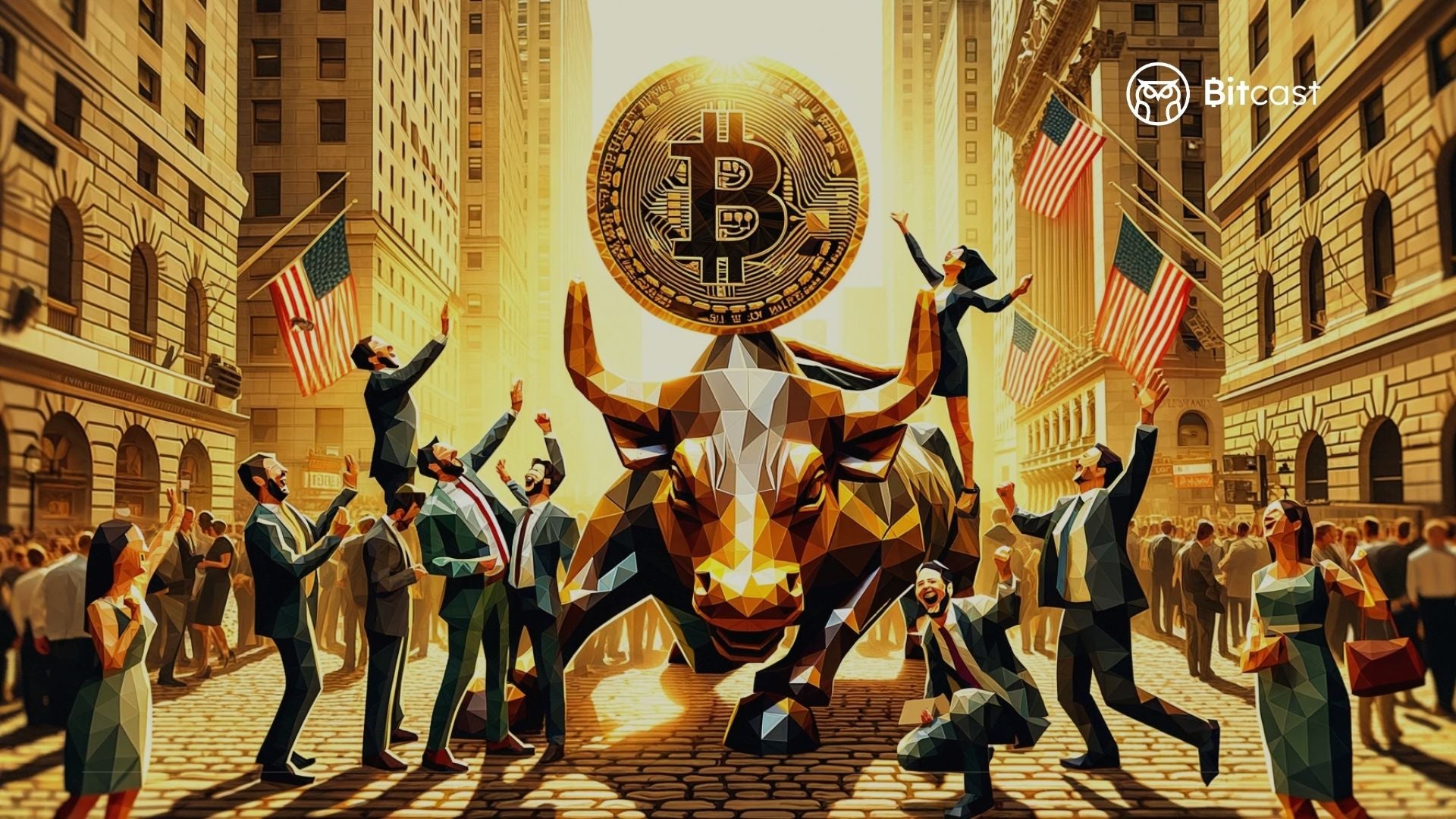
Introduction
I’ve been hearing the term “Bitcoin Spot ETF” for years. At first, I didn't understand why people were so hyped about it. Once I understood, I realized that it's a tool that makes it much easier for institutional and retail investors to invest. Personally, as someone who holds Bitcoin for the long term, I'm not that excited about the Bitcoin Spot ETF. The reason is that we're not looking at short-term results; we believe that in the long term, this is a point that must be passed anyway, and I'm tired of explaining it every time someone asks.
What is a Bitcoin Spot ETF?
What does Bitcoin Spot ETF mean? First, we need to understand what an ETF is. ETF stands for exchange-traded fund, an investment vehicle that allows general investors to directly invest in Bitcoin's price, tracking its movement on spot exchanges. It can be traded through brokerage accounts, making it easy for those who already have accounts to buy and sell. This instantly expands the customer base.
A Bitcoin Spot ETF aims to track the spot price of Bitcoin on exchanges as closely as possible, similar to buying an SET 50 fund. The key for such a fund is to match its price to the SET 50 as closely as possible; the less error in tracking, the better.
When I first learned about this type of fund, I thought, "Well, if it deviates and we profit, that's good." But in reality, whether positive or negative, if the price tracking has a high error rate, it means the management is not performing well.
A Bitcoin Spot ETF differs from a Bitcoin Futures ETF in that a Bitcoin Spot ETF invests directly in Bitcoin as the underlying asset, not in derivative contracts based on the price (this is like buying paper; in the case of Tulip Mania, it was buying futures). Simply put, we are buying the actual asset, not a ticket. It's like buying a condo: we buy the actual condo, not a booking confirmation or a right to ownership.
The Bitcoin Spot ETF and its 10-year journey

Going back to 2013, it was the first time that brothers Cameron and Tyler Winklevoss, twins who own Gemini, a digital asset exchange in the US, filed documents with the SEC to request a Bitcoin Spot ETF. During that time, Grayscale Bitcoin Trust (GBTC) was also born.
In 2016, the Winklevoss brothers made several attempts to revise their application for a Bitcoin Spot ETF, but it was still not approved. Grayscale also tried to convert its Grayscale Bitcoin Trust into a Bitcoin Spot ETF.
In 2017, the SEC rejected the Winklevoss brothers' application, leading them to give up during a period when the market was rising.
In 2018, the Winklevoss brothers' second attempt to file documents was also rejected, due to the SEC's concern that digital asset exchanges might not be able to control or prevent price manipulation according to standards.
In 2020, Grayscale converted its trust into an SEC-Reporting entity and began selling trust shares on "Pink Sheets." Although it wasn't an exchange-traded fund, it was the first time it could be traded by the general public, as typically, buying Grayscale Bitcoin Trust funds required a significant amount of capital and opening a specialized direct account.
In 2021, the first Bitcoin Spot ETF launched in Canada. In April of that year, Gary Gensler took over as Chairman of the SEC, replacing Jay Clayton.
In October of that year, the SEC approved the ProShares Bitcoin Trust for listing on the Chicago Mercantile Exchange (CME), making it the first Bitcoin Futures-Based ETF. Its initial trading volume was $1 billion, the highest compared to other ETFs.
In the same month, Grayscale also submitted a request to the SEC to convert its trust into a Bitcoin Spot ETF.
In 2022, the SEC rejected all applications, including those from SkyBridge, Fidelity, and Bitwise, as well as Grayscale's request to convert its trust. This led Grayscale to sue the SEC over the matter.
If you recall, that year saw many crypto-related companies collapse in a chain reaction, including Three Arrows Capital, Celsius Network, and FTX. I was one of the victims when these companies failed.
Bitcoin Spot ETF approved, amidst many people's hopes
In May 2023, Cathie Woods, founder of Ark Investment, filed for a Bitcoin Spot ETF, giving the SEC 240 days to consider it. This was followed by an application from a major player named BlackRock, which significantly boosted the hopes of people in the crypto world because everyone knew BlackRock was a major player with strong connections in the political sphere.
In August, the federal appeals court in Washington D.C. ruled in favor of Grayscale, stating that the SEC failed to explain why it rejected Grayscale's application. In the same month, Europe's first Bitcoin Spot ETF began trading on Euronext Amsterdam.
In October, the SEC backed down and chose not to appeal the court's decision in the Grayscale case, making it necessary to reconsider the application.
Finally, on January 10, 2024, the applications from BlackRock, Fidelity, VanEck, and Grayscale, along with 11 other applicants, were approved by the SEC. The day crypto enthusiasts had long awaited had arrived.
Just four days after approval, the cumulative value of Bitcoin Spot ETFs surpassed $11 billion, outperforming other commodity ETFs, second only to gold. The three major players dominating the market at this time are Grayscale, BlackRock, and Fidelity.
Bitcoin Spot ETF did not boost prices as everyone had hoped.
Many people expected to buy a Lamborghini after the Bitcoin Spot ETF was approved, but everyone was disappointed with the stagnant price. Currently, the price has dropped from $46,000 to $42,000. What are the reasons why Bitcoin's price isn't moving? Personally, I think it comes from two factors.
First factor: This price was already priced in by the market. For short-term traders, you've probably heard the saying "Buy the rumor, sell the news." Typically, short-term traders buy when there are rumors, and when the news actually comes out, it's their time to sell for profit. Therefore, I'm not surprised that when the Bitcoin Spot ETF was approved, people sold to take profits.
Second factor: The price is being suppressed by the sale of GBTC shares. The conversion of the Grayscale Bitcoin Trust into a Bitcoin Spot ETF means that the discount on the trust, which was as high as 50% in December 2022, is disappearing. After receiving the green light from the SEC to become a Bitcoin Spot ETF, this has become a significant downward pressure on Bitcoin's price.

Grayscale's GBTC sold 27,122 BTC in the first four days, representing only 4.4% of its total 619,200 BTC holdings. Personally, I believe the selling pressure from GBTC is a significant factor pushing the price down further than everyone expected. Currently, GBTC outflows continue, given that it was the first trust-like fund and has high management fees. These outflows are evident, while inflows into the other nine ETFs are gradually increasing. We'll have to wait and see when this trend ends, but GBTC still holds a substantial amount of Bitcoin, judging by current volumes.
https://x.com/EricBalchunas/status/1747385703971860617?s=20
Another interesting point is that the trading volume of Bitcoin Spot ETFs reached $10 billion in the first three days. If we look at all the ETFs launched in 2023, there were about 500 of them, and their combined trading volume was only $450 million. Comparing these figures, the difference is enormous. We can clearly see the potential of the Bitcoin Spot ETF by comparing it to all other ETFs combined; its trading volume is 22 times higher. This is just the beginning, and this story will unfold for a long time.
SEC's Concerns Regarding Bitcoin Spot ETF
The SEC has consistently used the argument that the regulatory standards of Bitcoin Spot ETF applicants might not be sufficient to prevent price manipulation, and even raised concerns about whether Bitcoin's liquidity would be adequate. I agree that these concerns exist, but I personally believe there's something deeper at play.
When I first started studying blockchain and Bitcoin, I had the opportunity to take an online course taught by Professor Gary Gensler before he became the Chairman of the SEC.
Gary Gensler is one of the people who understands Bitcoin very well, especially from a technical perspective. When he first took office, I expected his views and thoughts on Bitcoin to change for the regulatory sector, but that wasn't the case. However, one thing I always noticed in Gary Gensler's statements is that only Bitcoin itself is not a security; all other coins are securities.
Personally, I think Gary Gensler is quite worried about what will happen after he approves the Bitcoin Spot ETF, which is that other coins with owners will also request ETFs. That's why the price of Ethereum is soaring while Bitcoin's price remains quiet.
How the SEC views Bitcoin Spot ETFs
After the Bitcoin Spot ETF gained significant media attention and more people became aware of it, some brokerage firms saw this as a good opportunity to generate buzz. They began advertising, suggesting that retail investors could access Bitcoin Spot ETFs through applications that linked to these funds.
Soon after, the SEC issued a letter to caution brokerage firms against using this channel to attract retail investors to invest through them. Personally, I don't think this will have much impact on retail investors, as they can already buy through digital asset exchanges licensed by the SEC. However, it will affect brokerage firms that have funds and hope to implement strategies using these funds to allocate to Bitcoin Spot ETFs.
Because licenses to operate funds for investing in various assets are now separated into digital assets and traditional assets, I believe the SEC's decision to prevent licenses from crossing asset types is correct.
What investors should consider if they want to invest through Bitcoin Spot ETF
What investors should consider if they are to invest through a Bitcoin Spot ETF is the management fees. For many people, a management fee of around 0.25%, 0.2%, or 1% might not seem like much. But for me, if it's a long-term, passive investment, if we can manage it ourselves, we can easily reduce these management costs and turn them into profit. So, for anyone considering investing in a Bitcoin Spot ETF, I urge you to carefully consider the management fees.
Learning to self-custody Bitcoin is essential.
Self-custody is one way to reduce management costs, but it requires learning how to store Bitcoin securely.
Typically, to store Bitcoin securely, we use something called a Hardware Wallet. This Hardware Wallet is used to store our private keys.

This private key is the tool that confirms our ownership of Bitcoin. If we buy through a Bitcoin Spot ETF, the fund manager will contact a custodian service to store Bitcoin on our behalf. They use the same principle: they store the private key that specifies the right to possess that Bitcoin.
Personally, if anyone intends to hold long-term and is willing to learn, it will help us reduce costs and truly own Bitcoin through a Hardware Wallet. An example of a Hardware Wallet model I recommend and am a reseller for is OneKey. If interested, you can check the details in the store. Each model is suitable for different uses.
Conclusion: How much will the Bitcoin Spot ETF affect Bitcoin's price?
In the short term, with the Bitcoin Spot ETF, we can clearly see that not only did the price not go up, it actually dropped, for the reasons I explained above. So, does it affect Bitcoin? Personally, I think when we look at things like this, if we look at it over a longer period, like an investor, we will have a different picture and perspective. Why do I say that?

If we compare it to gold, because many people view Bitcoin as digital gold. In November 2004, the Gold ETF was approved. After that, the price of gold surged to its peak in June 2012, approximately eight years after the Gold ETF was approved.
In 2004, after the approval of the Gold ETF, by the end of 2004, the price of gold fell by -1.4% compared to its price at the time the Gold ETF was launched.
In the first year, the price fluctuated sideways, not moving significantly in either direction. For the first five months of 2005, gold prices dropped further. It wasn't until the third quarter of 2005 that the price started to rise, reaching $435.50 per ounce and closing the year at $513.00 per ounce, an increase of about 20% from the launch date of the Gold ETF.
From the example above, I don't mean that the Bitcoin Spot ETF will be identical to the Gold ETF. But what I want to convey is that having a Spot ETF doesn't necessarily mean the price of that asset will immediately increase. However, we can see that making Bitcoin into a Spot ETF will make it easier for financial institutions to access it. They can easily account for it in a familiar Spot ETF format, instead of having to account for direct Bitcoin trading themselves.
In the past, the price of gold depended on retail investors. But if you look at the price of Bitcoin now, institutional investors probably have a significant impact on it. We might need to observe this for a long time.
But another thing that I call the beauty of the Bitcoin ecosystem is the aspect of mutual giving.
VanEck's, one of the Bitcoin Spot ETF providers, offered 5% of its revenue to Bitcoin Core developers. This has been happening for a long time in the Bitcoin community, but not many people have highlighted this point. Many do not see the value creation for the system, and when the time comes, the system will provide value to itself.
What is evident is that the arrival of financial institutions creating Bitcoin Spot ETFs has made them a part of the Bitcoin ecosystem's stakeholders. And this arrival has fostered mutual support. Sharing 5% with Bitcoin Core developers is one thing that will make the Bitcoin ecosystem more sustainable.
What I've told you isn't meant to entice you to buy or get involved with Bitcoin. It's just to let you know that the story of value creation in the Bitcoin ecosystem is flourishing on its own, whether you enter this ecosystem or not.
References
https://www.investopedia.com/spot-bitcoin-etfs-8358373
https://www.reuters.com/technology/decade-long-journey-us-spot-bitcoin-etf-2024-01-10/
https://www.coindesk.com/markets/2024/01/11/grayscales-gbtc-discount-closes-to-zero-for-first-time-since-february-2021/
https://cointelegraph.com/news/spot-bitcoin-etfs-one-week-later-btc-sells-off-but-etfs-reap-success
https://ocw.mit.edu/courses/15-s12-blockchain-and-money-fall-2018/

แชร์:
Hardware Wallet Comparison Part 1
6 problems that make you unable to find your coins in your hardware wallet
1 comment
ขอบคุณความรู้ดีๆค่ะ ทำให้คลายข้อสงสัยเลยค่ะ